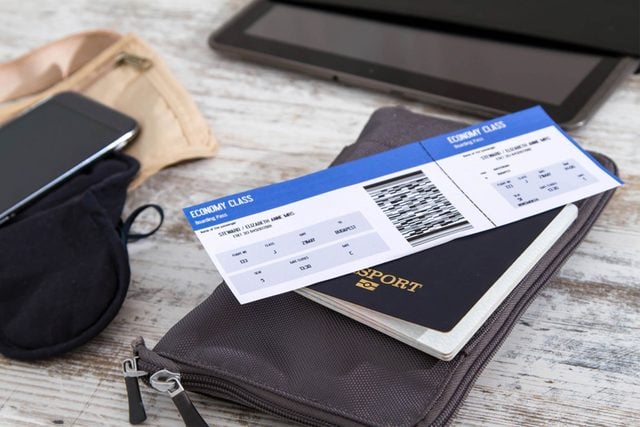
Aah, the thrill of a fresh boarding pass in your hand. It’s the moment you first hold the golden ticket to your beach escape or bucket list trip and feel the anticipation of adventures ahead. Yet immediately after you board the plane, that pass promptly loses its magical powers and you shove it into the seat back pocket or toss it into the nearest trash bin when you deplane. While this may be a common and seemingly harmless practice among travelers, experts say this is definitely not what to do with a boarding pass.

“You should never leave your boarding pass on the plane or discard it in public places, even after your flight,” says Dave Lewis, a security expert with 30 years of experience who is the global advisory chief information security officer at 1Password. So what’s the big deal, and what should you do with your boarding pass?

Ahead, Lewis and Eva Velasquez, the CEO of the Identity Theft Resource Center, explain everything you need to know about the boarding pass, including what to do with it, how to discard it safely and whether a digital boarding pass is better than a paper one. Keep reading to learn more.

Get Reader’s Digest’s Read Up newsletter for more travel, humor, cleaning, tech and fun facts all week long.

Why shouldn’t you throw away your boarding pass?

You should never throw your boarding pass away in public places, leave it on the plane or post it on social media because scammers can use the barcode to access sensitive personal and travel information, Lewis explains. But that barcode can only be read by airport scanners, right? Wrong. “Anyone with a simple barcode scanning app or online decoder can extract this data,” Lewis says. Yikes!

Even before it’s time to say goodbye to your boarding pass, you should keep it covered as much as possible to avoid “shoulder surfing.” That’s when someone collects your info by peeking over your shoulder in a public place. As a frequent solo traveler, I’m hyper-aware of people standing close to me in line, and I only take my boarding pass out when necessary, such as when security or airline reps request it.

What kind of information is on your boarding pass?

Your boarding pass contains a lot of information, including your full name, flight route and frequent flier or airline loyalty account number. That number is often associated with other details, such as your home address, phone number and airline points.

Lewis says the International Air Transport Association (IATA) sets most of the standards for what is found on each boarding pass. In addition to your name and personal information, boarding passes include “key flight details such as the airline code, the flight number, date of travel, departure and arrival airports, the assigned seat number and the class of service (for instance, Y for economy or J for business).”

woman looking at her boarding pass
Malik Evren/Getty Images

And all that is viewable at a glance! Add in a scanner, and a scammer can access even more info. “The barcode stores ticketing details, including whether the passenger holds an electronic ticket, the operating and marketing carriers, any associated frequent flyer numbers and the sequence in which the passenger checked in,” Lewis explains. It could even let scammers know whether you need special assistance, such as a wheelchair, or whether your child is flying as an unaccompanied minor. That’s quite a bit of info for such a small piece of paper!

What can scammers do with the information on your boarding pass?

They can change your flights, hijack your airline account, lure you into sharing more info through phishing scams or even steal your identity. For example, with the personal details connected to your airline account, scammers could call you to obtain sensitive info, such as your passport or payment details. In one of many such scams discussed on Reddit, users recount how scammers pose as Air China reps and pressure the victim into sharing passport and “verification” details over the phone.

“The real danger lies in how easily this information can be weaponized,” Lewis says. “With just a name and PNR [passenger name record], an attacker could log into an airline’s website and hijack an account or steal accumulated travel miles.” More sophisticated scammers could mock up emails that appear to come from an airline, and Lewis says in extreme scenarios, “such details could even be used for identity theft or to track the movements of high-profile individuals.”

According to a report by Arkose Labs, frequent flier accounts are particularly vulnerable because airlines allocate most of their budget to aircraft operations, leaving only about 7% of their overall IT budgets for cybersecurity. Low budgets, outdated systems and a rise in cybercrimes are a dangerous combination, so it’s best to keep that boarding pass close!

Is your information safer if you don’t have a frequent flier account?

Even without a frequent flier account, some personal and travel data will still be connected to your boarding pass, and therefore vulnerable if someone gets ahold of it, Velasquez says. “Leaving your boarding pass in a public place is like leaving a credit card receipt behind. While the information is limited, it is still your personal data.”

Think of it like this: “A boarding pass is a piece of the puzzle for someone to unwind the information about your life,” Lewis explains. With just a few of the details on your boarding pass or luggage tags, someone can potentially find out much more about you. “There were times when I was standing in line at an airport waiting for a taxi, and I would amuse myself by looking at the luggage tag on the bag of the person in front of me, as well as anything distinguishing, such as a name tag or picture of family,” Lewis says. “Then I would search online to see if I could discern who they were, where they worked and where they went to school. I was never stumped in this endeavor.”

While Lewis played this investigative game just to pass the time, it proves that scammers could use that info—without any attached frequent flier account—to connect the dots to more personal details that they could then use for phishing or phone scams, identity theft, account takeovers and more.

Is a digital boarding pass better than a paper one?

In some ways, yes, but they come with a few tech-related drawbacks. “You’re at the mercy of technology and power failures, such as when your phone battery runs flat or there is a possible software glitch,” Lewis explains.

But the digital version does alleviate some risks. “Using an electronic boarding pass eliminates the need to [worry about where and how to] discard a physical one,” Velasquez says. And Lewis says that the digital pass has more security features, thanks to a combination of encryption, restricted access and tighter integration with airline and airport systems.

“Unlike paper passes, which can be lost, photographed or even forged, digital passes are stored securely on smartphones, often protected by biometric authentication or device passcodes,” he says. “Many are issued through airline apps or mobile wallets, making them difficult to duplicate or tamper with.” Some digital passes may even include cryptographic signatures or time-sensitive QR codes that expire after use, Lewis adds, reducing the risk of fraudulent boarding.

Digital boarding passes also tend to be more convenient because you can’t misplace them the way you might a paper one. “If a digital pass is compromised, it can be quickly revoked and reissued by the airline, which is not possible with paper tickets,” Lewis says. “Digital passes are also linked in real time to flight databases and security systems, ensuring that the information displayed is current and verified. This added layer of protection makes digital passes a more secure and reliable option for air travel.”

Should you get both?

Even with the advantages of digital boarding passes, Lewis hasn’t given up on printed passes. He always gets one in addition to the digital one (as a seasoned traveler, so do I). And he recommends all travelers do the same, in case they encounter technical issues with the digital version (or, you know, exhaust their phone battery on streaming movies and music).

Is there any reason to hold onto your boarding pass post-flight?

Unless you’re planning to use your printed boarding pass for scrapbooking or creating some type of memento that will be safely stored at home, Lewis says there’s no reason to hang onto the physical boarding pass once you’ve completed your trip. If you need the details for an expense report or to ensure you get your frequent flier miles, simply snap a photo of the boarding pass before discarding it.

How can you safely discard your boarding pass?

According to the experts, the safest way to discard your paper boarding pass is to shred it before throwing it out. For digital ones, delete them from your mobile device.

“While a boarding pass is lower risk than other sensitive documents, we encourage people to get in the habit of properly destroying (shred, cut up, take it to a shredding company, etc.) documents with their personal data rather than leaving them out or throwing them [fully intact] in the trash,” Velasquez says. “When you treat all your data with care, it becomes a simple, routine practice.”

About the experts

  • Dave Lewis is a security expert and consultant with 30 years of experience. He is the global advisory CISO (chief information security officer) at 1Password and host of the Chasing Entropy podcast, an interview series featuring cybersecurity, technology and AI professionals.

  • Eva Velasquez is the CEO of the Identity Theft Resource Center. She is a recognized expert in identity compromise, cybercrime and fraud. Velasquez received the National Crime Victim Service Award from the U.S. Department of Justice and the National Consumer League’s Florence Kelley Consumer Leadership Award for her work in assisting victims, educating the public and advocating for change.

Why trust us

Reader’s Digest has published hundreds of travel stories that help readers explore the world safely, easily and affordably. We regularly cover topics such as the best places to visit (and the best times to visit them), tips and tricks to zoom through airport security, flight-attendant secrets, hotel-room hacks and more. We’re committed to producing high-quality content by writers with expertise and experience in their field in consultation with relevant, qualified experts. We rely on reputable primary sources, including government and professional organizations and academic institutions as well as our writers’ personal experiences where appropriate. We verify all facts and data, back them with credible sourcing and revisit them over time to ensure they remain accurate and up to date. Read more about our team, our contributors and our editorial policies.

Sources: