Before the rubber hits the road, you need to make sure your tires are safe. This easy, at-home tire tread test will ensure yours are up to speed.
This 1-Second Tire Test Could Save Your Life
Years ago, I was on my way to work on a dark, snowy morning. Visibility was limited as snow gusts swirled around me, but a quick glance to my right revealed several cars stranded in a ditch. That’s when I spotted a semi-truck’s red brake lights flashing several feet ahead of me on the highway. I held my breath, gripped the wheel and tried not to panic as I gently stepped on the brake. To my relief, my car slowed and glided along the snow as I maneuvered around the truck. I exhaled and sent a silent thank-you to my dad, an automotive engineer and a stickler for safety who insisted that I regularly do a routine tire tread test to ensure my tires were in good shape.
Fast-forward a few decades. As a car journalist, I’ve driven hundreds of vehicles and interviewed countless experts. I always recommend regular tire checks, especially for drivers who contend with wintery and wet climates. According to the National Highway Traffic Safety Administration (NTS), nearly 650 fatalities occurred due to tire-related crashes in 2023. It’s heartbreaking to think how many of these collisions could have been avoided—and potential lives saved—if drivers had used the easy one-second test my dad taught me. The moral of the story: Listen to your father’s advice.
So what is the tire tread test exactly, and how can it prevent accidents? In addition to what I know from my dad, I spoke with Ian McKenney, senior product strategy manager for Bridgestone, who agrees that this one-second tire tread test can be a literal lifesaver. Keep reading to learn the simplest way to stay safe on the road.
Get Reader’s Digest’s Read Up newsletter for more car tips, humor, cleaning, travel, tech and fun facts all week long.
What is tire tread?
Tire tread is the part of the tire that meets the road. Its telltale pattern of ribs runs around the circumference of the tire, and those grooves and slots are designed to allow water or snow to slip off the tires, which helps stop the car from skidding.
Over time, these grooves can wear down, an indication that the tire needs to be replaced. “If you don’t have enough void area to evacuate that water, then you’re going to create a hydroplaning scenario in which you lose control of the vehicle,” McKenney says. “[This will last] until your speed is reduced enough to where you can regain contact with the road.”
What’s a fast, easy way to check your tire tread?
The one-second tire tread test is a free and easy way to ensure that tires are intact and in good working order. It’s very simple: You insert a coin—ideally a quarter—upside down into your tire to identify the size of the raised section. Basically, if George Washington’s head is covered by the grooves of the tire, the tread is in good shape. (More on the nuances of conducting the test below.) Fun fact: For decades, experts actually recommended a penny for this test. But in 2007, Tire Rack began to recommend using a quarter for the test, and the industry followed suit. A quarter works better because its larger surface can better measure depth.
The quarter test gives you a quick snapshot of what’s going on, so you know right away if there’s a problem. “In the fall before going into a winter season it would be very critical to check your tread depth,” McKenney says. On the flip side, you don’t have to pay for a mechanic to tell you that nothing’s wrong.
Here’s what you need to know:
How to check tire tread with a quarter

First things first. Put the car in park, turn off the engine and find a quarter. Then …
- Take a quarter and turn it upside down so that George Washington’s head faces downward. Insert the quarter into the ribbed tire tread. The tire is in good working condition if the top of Washington’s head is covered, indicating a measurement of above 4/32 inches or 3.2 mm deep.
- Check the tire tread with the quarter at different points in the tire to ensure consistent measurement.
- Be sure to measure all four tires, since tires can wear down at different rates.
- If the top of Washington’s head is visible at any point due to shallow grooves, it’s time to replace the tire.
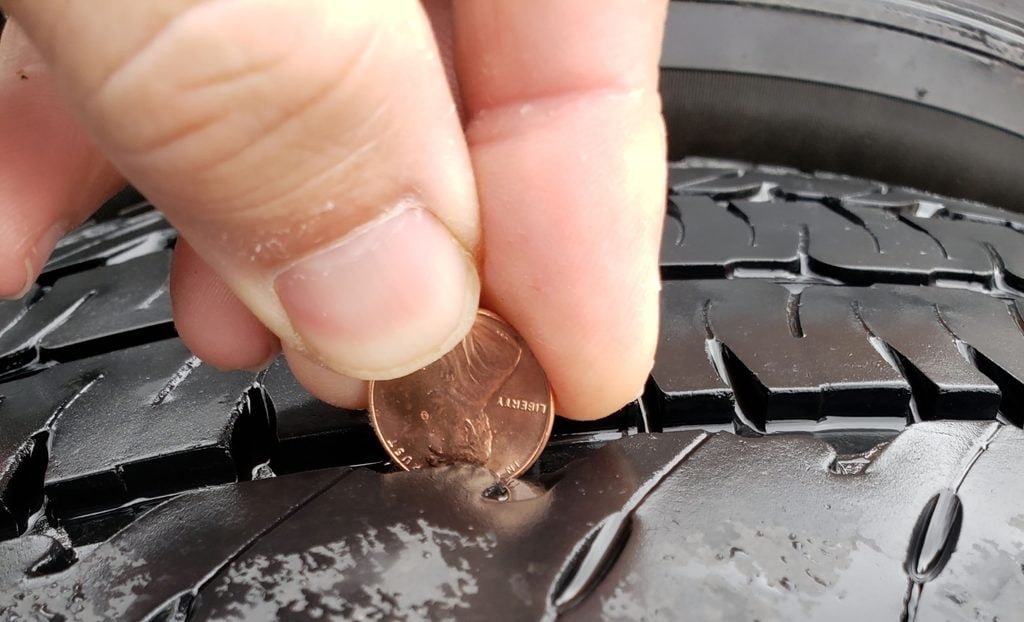
How to check tire tread with a penny

If you can’t dig up a quarter, a penny can still provide a barometer of tire tread condition.
- Turn the penny upside and insert it into the tire tread.
- Follow the same steps as the quarter test to determine if Abraham Lincoln’s head clears the surface, an indicator that the tire has more than 2/32 inches of tread.
- Check the tire tread with the penny at different points in the tire to ensure consistent measurement.
- Be sure to measure all four tires, since tires can wear down at different rates.
- If using a penny, the margin for error is non-negotiable, which is why some experts recommend the quarter. If the tire doesn’t pass the penny test, the tire is unsafe and possibly illegal. “You’ve lost enough void in your tire and the circumferential grooves in the shoulder slots that you’re already at risk for hydroplaning if you’re somewhere where it’s wet,” McKenney says.
The difference between the penny and quarter tests is that if your tires don’t pass the penny test, it’s time to replace them immediately. Most states have laws that require at least 2/32 inches of tire tread and may issue citations for tires in poor shape.
What are some other ways to check tire tread?
McKenny’s top choice for a precise tire tread test is a tire gauge, a small, inexpensive device purchased at automotive-parts stores or online that can be stored in the glove box to measure the distance of the grooves. (Tire gauges come in both analog and digital versions.) Here’s how to use it:
- Insert the probe into the circumferential groove of the tire.
- Lower the gauge to the flat area that sits on top of the tread.
- The tire gauge numerically displays the exact measure of the tire tread. Like the quarter test, it should be above 4/32 inches. The gauge provides an exact number.
Another way to check tread is to eyeball the tire for markings on the wear bars that display overuse, but a more accurate testing source is recommended by most experts. And, of course, if you’re driving and you notice a change in performance, have difficulty stopping or the car is pulling to one side, it could be an indication that the tires are in need of replacement.
How often should you check tire tread?
Tire tread should be checked monthly. While you’re at it, check the tire’s inflation, which can also impact tread if under- or overinflated. Another key to good tire tread that McKenney stresses is the importance of regular tire rotation. Follow manufacturer guidelines, but a good rule of thumb is to check tire rotation during regular oil changes every 5,000 to 7,000 miles. New tires typically measure 10/32 inches to 11/32 inches.
And, of course, if you’re in doubt about the tire tread test, a mechanic could confirm the results and the need to purchase new tires.
At what tread depth do tires need to be replaced?
The tires need to be replaced immediately if they don’t pass the penny test, which is less than 2/32 inches, or soon after failing the quarter test, or less than 4/32 inches or 3.2 mm deep.
The final key factor is knowing when it’s time to replace your tires. “We recommend six years as probably an appropriate working life for tires,” McKenney says. “And we draw a hard line at 10 years.” That said, the timing can vary based on how many miles you drive.
What other factors impact tire tread?
- The weight of the vehicle can negatively impact tire tread. A large, hefty SUV, for example, is likely to wear down the tire at a quicker rate than a sedan.
- Electric vehicles weigh more than gasoline-powered cars, partially due to the vehicle batteries, and use more torque that impacts tire use. An EV can wear through tires at a rate of 10% to 30% faster than gas counterparts, and owners might need to replace tires between 20,000 and 40,000 miles.
- The number of miles driven, driving style and driving conditions also impact tire wear and tear. Tire tread is most essential for drivers who live in wet and wintery climates.
Are there ways to improve your tire’s tread wear?
Drivers can take several steps to ensure tires stay in good, working condition.
- Mitigate aggressive driving with gentle braking and accelerating.
- Keep tires at proper inflation, and tend to regular tire rotation maintenance.
- Switch to all-season or winterized tires in wet or wintery climates.
- Be mindful of driving on roads that have uneven surfaces.
- And, of course, paying attention to tire tread keeps your car driving smoothly on the road ahead.
About the expert
|
Why trust us
At Reader’s Digest, we’re committed to producing high-quality content by writers with expertise and experience in their field in consultation with relevant, qualified experts. We rely on reputable primary sources, including government and professional organizations and academic institutions as well as our writers’ personal experiences where appropriate. We verify all facts and data, back them with credible sourcing and revisit them over time to ensure they remain accurate and up to date. Read more about our team, our contributors and our editorial policies.
Sources:
- Ian McKenney, senior product strategy manager at Bridgestone America; phone interview, Oct. 22, 2025
- The National Highway Traffic Safety Administration: “Tires”
- U.S. Tire Manufacturers Association: “National Tire Safety Week”
- Tire Rack: “What Honest Abe Doesn’t Tell You About Minimum Tread Depths”
- Cars.com: “Do EVs Wear Through Tires More Quickly Than Gasoline Cars?”