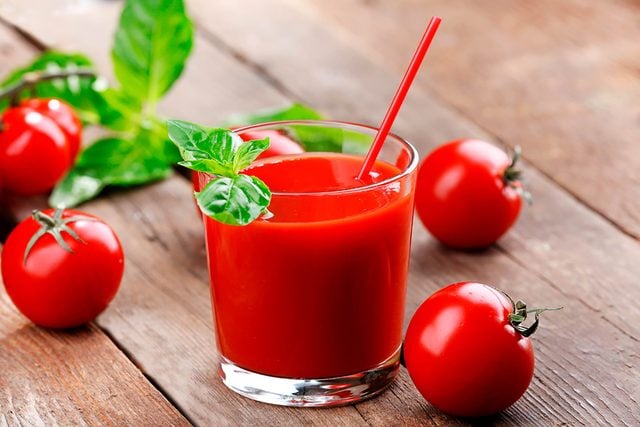
Even if you normally don't like tomato juice, your taste buds will thank you mid-flight
Here’s Why Tomato Juice Tastes Better on Planes (And No, You’re Not Imagining It!)
My husband loves tomato juice—it’s one of his many endearing quirks, right up there with his obsession with old maps and his insistence on rolling down the windows before turning on the AC “to push the hot air out.” But while he likes tomato juice any time, the only time he actually seeks it out is when we’re flying. The moment that beverage cart rattles down the aisle, he lights up like a kid at Christmas. “Do you have tomato juice?” he asks eagerly before cradling his little plastic cup like it’s a fine Bordeaux.
This has always baffled me. Tomato juice? Really? It’s not exactly a go-to thirst quencher. It’s not even refrigerated in most grocery stores. So why is it his No. 1 in-flight drink? Why do the airlines always seem to have it stocked and ready? And how many other weirdos only drink tomato juice on planes?
A lot, it turns out. And food scientist Bryan Quoc Le, PhD, author of 150 Food Science Questions Answered, is one of them. “I love tomato juice only on airplanes—it’s literally the only time I drink it,” he says. “And it tastes amazing!”
OK, so tomato juice tasting better on airplanes is really a thing? “It’s definitely a thing—a scientific thing, actually,” Le says. “There’s been research into it, and it’s been proven true, as funny as it sounds.”
Incidentally, when I first reached out to Le about this interview, he replied, “I love this topic, and I can talk your ear off (unfortunately for you), so you are now my captive audience!” No captivity necessary—I’m apparently a sucker for tomato-juice nerds. I was super excited to get all the juicy details on this strange-but-true subject. Read on to find out why you might have this strange craving when you’re at 30,000 feet.
Get Reader’s Digest’s Read Up newsletter for more travel, tech, cleaning, humor and fun facts all week long.
Does tomato juice really taste better on planes?
The short answer: yes. And we’re not just being dramatic. More than two decades of research—and plenty of in-flight drink orders—support the claim that tomato juice tastes different (and often better) when you’re flying. In 2010, a Lufthansa-commissioned study conducted by the Fraunhofer Institute for Building Physics found that people preferred tomato juice on planes far more than they did on the ground. According to their data, the airline served about as much tomato juice as beer. Yes, beer.
Then, in 2015, a study out of Cornell confirmed this and expanded on the scientific reason it happens. Ten years later, in 2025, the trend holds strong. In fact, flight attendants often cite tomato juice as one of the most-requested drinks on flights.
“I see it all the time,” says Cecily Anderson, a flight attendant with more than two decades of experience working for every major U.S. airline. “People will tell me that they never drink it normally, but it hits differently in the air. They’ll even ask me what brand we use and if it’s a special, fancy kind. But it isn’t! It’s the regular stuff you buy in the grocery store.”
It’s almost like something has hijacked these fliers’ taste buds. And as it turns out, that is kind of what happens, Le says.
Why does tomato juice taste better on a plane?

To understand this phenomenon, we have to go full Bill Nye for a minute. Your taste buds don’t work the same at cruising altitude, and it’s not just in your head—it’s in your ears, nose and even your evolutionary wiring.
The plane is loud
Loud airplane noise literally changes your sense of taste, due to a phenomenon called psychophysics. “Your brain gets overwhelmed by the loud noises on the plane, and that dims your taste buds—except for umami, which, for whatever reason, is actually amplified,” Le says.
But how? In one of the most fascinating (and oddly specific) studies on this, researchers at Cornell played loud airplane noise—around 85 decibels, similar to what you’d hear in the cabin—for 48 participants as they tasted samples of sweet, salty, sour, bitter and umami flavors.
The results? Noise didn’t affect salty, sour or bitter tastes. But sweetness got significantly dulled, while umami (the savory flavor) actually became stronger, especially at higher concentrations. “Sweet-taste intensity was rated progressively lower, whereas the perception of umami taste was augmented,” the researchers wrote. In other words: Your Diet Coke hits weird, but your tomato juice? Chef’s kiss.
Your sense of hearing and taste get “cross-wired”
Why does sound mess with taste? The Cornell study suggests it might be due to mechanostimulation of the chorda tympani nerve, a fancy term for a nerve that passes right by your eardrum on its way to your tongue. That nerve helps transmit taste signals, and when it’s jostled by noise—like, say, a jet engine—your taste perception shifts.
And it’s not just your taste buds getting confused. It’s your whole head. Le adds that this cross-sensory effect is well documented in other instances, like when doctors use a “buzzing” ring to help kids not feel the pain of injections. It’s a similar effect with umami.
Tomato juice is the MVP of umami
Umami is the savory, brothy flavor found in things like mushrooms, soy sauce and—you guessed it—tomatoes. Specifically, tomatoes are packed with glutamic acid, a compound that sits at the top of the umami scale. (That’s also why ketchup, pizza sauce and marinara somehow feel extra delicious when you’re jetting over the Rockies.)
“Why is it just umami taste that becomes heightened when the senses get overwhelmed?” Le says. “We’re not totally sure why—it might be evolutionary—but it’s a real effect.”
The cabin air is dry
Flavor is a team effort between taste and smell, but that teamwork breaks down on planes. Cabin air is extremely dry—less than 15% humidity—which dries out the nasal passages. “Taste receptors require a certain level of moisture to interact with flavor compounds,” explains Le. “With lower moisture, your ability to detect nuanced flavors like sweet and bitter goes way down.”
That leaves you with what scientists call “blunted” taste perception.
The cabin pressure changes
Flying messes with your body in a lot of subtle ways, and that includes the pressure in your inner ear and brain. The change in cabin pressure is similar to being at about 8,000 feet above sea level. This affects hearing—sounds get muffled—which, thanks to psychophysics, affects your taste too. It’s a sensory rerouting.
“It’s a similar cross-wiring between the senses,” Le explains. “Hearing influences taste, so when your hearing is dulled, your brain adjusts. Umami flavors come through stronger, while others, like sweetness, are suppressed.”
The airplane environment
Everything in your environment—from the music to the lighting to the smell—influences your sense of taste. Smart airlines know this and will design the plane environment to enhance taste (and sell more drinks). In fact, some work with food scientists to build menus around these in-flight taste shifts. “This is why they up the salt content in airplane food,” Le says. “Salt receptors are dimmed so they have to add extra salt to make it taste ‘normal.’ Sugar is perceived poorly, so they usually don’t add extra sugar.”
Even ice can make a flavor difference. “Ice decreases your perception of taste, in the air and on the ground,” says Le. So if your tomato juice feels a little overwhelming, you might want to ask for it on the rocks (though that can bring other issues).
Are there any benefits to drinking tomato juice on an airplane?

Yes, with a few caveats. Tomato juice is rich in vitamin C, potassium and antioxidants like lycopene, which can support hydration and circulation, both important during long flights, Le says. It also contains electrolytes, which can be helpful in offsetting dehydration (especially in that dry cabin air).
But it’s not all good news. “Tomato juice can be really high in sodium,” Le says. “So if you’re trying to reduce salt intake or dealing with blood pressure issues, it might not be the best choice.”
And if you’re mixing it with vodka—hello, Bloody Mary—you’re not doing your body any favors hydration-wise. Alcohol can increase dehydration and make jet lag worse. But we’re not here to judge. (Just maybe hydrate before and after drinking one.)
Wondering when to drink it? Tomato juice pairs surprisingly well with salty snacks like pretzels or cheese crackers—foods often served on flights. Mid-morning or early afternoon flights tend to be the most popular times for tomato-juice orders.
Can you get tomato juice on all airlines?
Most major airlines do carry tomato juice, though availability can vary depending on the airline, the route and even the country, Anderson says. It’s typically offered for free on full-service carriers (like Delta, United and American Airlines), though some budget airlines may charge for it or skip it altogether in favor of simpler options.
Tomato juice has been a staple in the sky since the 1960s, when airlines started looking for flavorful beverages that could hold up in the uniquely flavor-dampening environment of an airplane. Since then, it’s become iconic.
Anderson says it’s one of the drinks they never run out of. “People will skip soda, wine—even water—but they’ll ask for tomato juice by name,” she says. “It’s like part of the flying ritual now.”
Do any other airplane drinks work similarly?
Ginger ale is another heavy hitter when it comes to sky-high cravings—and the only other drink Le says he drinks while flying. It’s mild, slightly spicy and famously gentle on upset stomachs, making it a go-to for nervous fliers or folks with motion sickness. Plus, the carbonation makes it feel celebratory without the side effects of alcohol.
A few others worth noting:
- Club soda or sparkling water: The bubbles provide sensory stimulation, which helps with dulled taste buds.
- Green tea: Light and calming, it doesn’t overload the taste system.
- Bloody Mary mix: Technically tomato juice plus spices (and maybe a celery stick), but it deserves its own mention.
After I learned all this, I asked my husband why he prefers tomato juice on planes. His answer: “It feels healthier than the other options, and I know this sounds weird, but for some reason I swear it just tastes better.” Hoo boy, am I going to blow his mind!
So if you too love tomato juice on planes, just know: You’re not being weird. You’re just being … airborne.
About the expert
|
Why trust us
Reader’s Digest has published hundreds of travel stories that help readers explore the world safely, easily and affordably. We regularly cover topics such as the best places to visit (and the best times to visit them), tips and tricks to zoom through airport security, flight-attendant secrets, hotel-room hacks and more. We’re committed to producing high-quality content by writers with expertise and experience in their field in consultation with relevant, qualified experts. We rely on reputable primary sources, including government and professional organizations and academic institutions as well as our writers’ personal experiences where appropriate. For this piece on tomato juice on planes, Charlotte Hilton Andersen tapped her experience as a longtime journalist who covers common curiosities, travel facts, health and etiquette for Reader’s Digest. We verify all facts and data, back them with credible sourcing and revisit them over time to ensure they remain accurate and up to date. Read more about our team, our contributors and our editorial policies.
Sources:
- Bryan Quoc Le, PhD, food scientist, author of 150 Food Science Questions Answered and founder of Mendocino Food Consulting; phone interview, Aug. 14, 2025
- Fraunhofer Institute for Building Physics IBP: “Everything tastes different in the air – the effects on the taste experience in the aircraft cabin”
- Journal of Experimental Psychology: “Human Perception and Performance — A Crossmodal Role for Audition in Taste Perception”