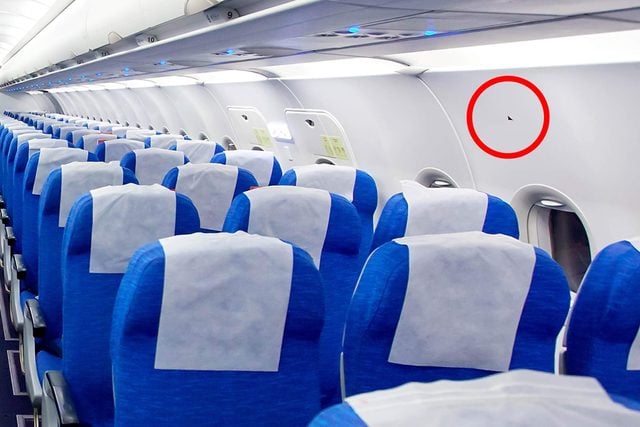
There’s a lot going on when you’re boarding a plane. After you jockey for position at the gate, shuffle down the jetway and grab an overhead bin, the last thing you probably notice as you take your seat is the space above the window. Sure, you want to have a window in the first place, but mainly you just want to get settled and on your way. But the next time you fly, take a closer look at the wall. You just might spot a little red or black triangle above the airplane seat.

Usually, you can spot one or two of these triangles on each side of the cabin. But do you know why they’re there? (Hint: it’s not for decoration.) Airplanes are full of mysterious quirks, and these tiny triangles are no exception. They serve a very important role for the crew, one that can be critical both before and during flight. Intrigued? We talked to Daniel Bubb, a former commercial pilot and aviation scholar, to get the full story.

Read on to find out why they’re there and what they mean for you and your flight.

Get Reader’s Digest’s Read Up newsletter for more knowledge, cleaning, humor, travel, tech and fun facts all week long.

What are those little triangles above airplane seats for?

Inside the cabin, those triangles show which windows give you the clearest view of the plane’s wings. “The primary reason why the triangle exists is to assist flight crew members when there is an emergency or malfunction of the wing flaps, slats, engine and other parts,” explains Bubb. “It helps them identify the location of the problem more expeditiously.”

Even when there’s no emergency, the triangles still come in handy. “The crew will look out the window to make sure that the wing is being deiced and that there are no abnormalities,” Bubb adds.

Where, exactly, are those triangles located in the cabin?

The-Hidden-Meaning-of-the-Triangle-Stickers-Above-Your-Airplane-Seat--117567658-My-Good-Images
My Good Images/shutterstock

There are at least two triangles in most airplanes, each right above a window on each side of the cabin and lined up with the edges of the wings outside. “On larger passenger planes, passengers might see two triangles marking the leading and trailing edges of the wing,” Bubb says.

How can they be helpful to you?

The most obvious perk of sitting by the triangles is the view. The black-triangle airplane seat is a perfect spot to take in the scenery or take Instagram-worthy photos on your phone. And these seats can be a comfort for nervous fliers needing reassurance because you can fully see pre-takeoff deicing in action in bad weather.

They also offer passengers the promise of a smoother ride since seats slightly ahead of or behind the wing’s centerline are often less affected by turbulence and that dramatic dropping feeling after takeoff.

Which seat numbers generally have these triangles over them?

The triangles are always above the windows at the front and back of the wing edges, but the exact seat number really depends on the aircraft and its layout. Unfortunately, Bubb says that the triangles are not always located in exit rows and aren’t indicated when booking—so there’s no guaranteed way to reserve one.

You should know that larger Airbus and Boeing planes are more likely to have them, while regional jets and small private planes or light aircraft may not. And certain airlines or older aircraft may omit the markings entirely, as they’re not a regulatory requirement but a practical crew aid.

Determined to better your chances of scoring a window seat with a triangle? Select seats closest to each edge of the wing on the airline’s seat map.

What is the seat with the triangle’s quirky nickname?

There’s no official name for the triangle seat, but if you’re seated in a spot featuring the special mark, congratulations! You can boast that you officially flew in what is sometimes called the “William Shatner seat.”

The reference comes from “Nightmare at 20,000 Feet,” an October 1963 episode from season five of The Twilight Zone, starring the actor. In the episode, Shatner’s character, Bob Wilson, looks out the window of his seat near an emergency exit and spots a creature on the wing attempting to sabotage the flight.

Is there anything special you should do if you’re sitting in this seat?

All passengers in the triangle seats generally need to be concerned about is sitting back and enjoying the flight (and that view!). “Unless they are given a specific request by a flight crew member, there is nothing they are supposed to do, unlike passengers who sit in exit rows, where they must be willing to assist the flight crew in an emergency,” Bubb says.

About the expert

  • Daniel Bubb, PhD, is a former pilot and an associate professor in residence at the University of Nevada, Las Vegas Honors College. He served as a first officer, flying 15-passenger Beechcraft 99s. Bubb is also the author of Landing in Las Vegas: Commercial Aviation and the Making of a Tourist City.

Why trust us

Reader’s Digest has published hundreds of travel stories that help readers explore the world safely, easily and affordably. We regularly cover topics such as the best places to visit (and the best times to visit them), tips and tricks to zoom through airport security, flight-attendant secrets, hotel-room hacks and more. We’re committed to producing high-quality content by writers with expertise and experience in their field in consultation with relevant, qualified experts. We rely on reputable primary sources, including government and professional organizations and academic institutions as well as our writers’ personal experiences where appropriate. We verify all facts and data, back them with credible sourcing and revisit them over time to ensure they remain accurate and up to date. Read more about our team, our contributors and our editorial policies.

Source:

  • Daniel Bubb, PhD, former first officer at Air Vegas Airlines, associate professor at the University of Nevada and author of Landing in Las Vegas; email interview, October 2025