


Here’s Why You Really Shouldn’t Have Bumper Stickers on Your Car
Updated: Nov. 27, 2022





There's no need to let paranoia get the best of you—but it's a good idea to keep this in mind.
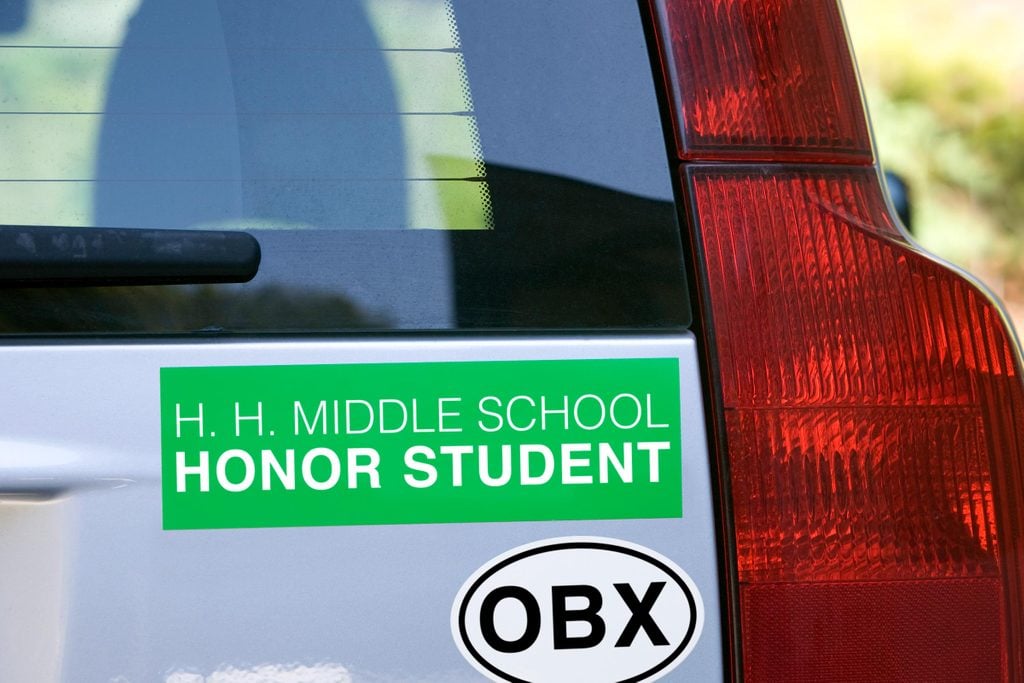
We get it—you love your life, and you’re proud of your family. Those little stick-figure-family decals you want to stick on your car are adorable, and you are super proud that your kids made the honor roll. (And, hey, their school was selling those bumper stickers for a fundraiser!) The problem, however, is that you might be inadvertently putting yourself and your family in danger by announcing things like that to the world. When you think about it, those stickers reveal a surprising amount of personal information, and that gives criminals the upper hand they need to potentially commit fraud, theft, and other crimes.
How big is the risk?
Before we get into the nitty-gritty, a disclaimer: Studies have shown that most stalking victims are preyed upon by individuals they know personally, says Kent Bausman, PhD, a sociology professor at Maryville University. “The stereotype of the ‘stranger’ stalker lurking in the shadows [and] looking for visual cues of vulnerability is more of an urban legend,” he adds.
However, that doesn’t mean you shouldn’t take all of the safety precautions you can to stay out of harm’s way. “Safety is not about being paranoid—it is about being smart and being aware of what information we are sharing with the world,” says Ashley Glinka, a former federal law enforcement agent. “Criminals are opportunists; they prey on easy targets.” With that in mind, here’s what your bumper stickers are telling them.
They can reveal where you and your family spend your time
Do you take frequent ski trips in the winter? Or maybe you can’t get enough of the sun and prefer to vacation in warmer climates? Either way, letting strangers know that you might be gone for prolonged periods of time is problematic—especially if your bumper sticker notes your destination of choice. “Stickers that show frequent vacation spots could inform burglars that your home is left unattended during vacation seasons,” explains Corporal Tina McGriff with the Montgomery Police Department. “This creates an opportunity for property damage and loss.” Don’t miss these 22 inexpensive ways to burglar-proof your home.
They could put your children in danger
Personalized bumper stickers with your children’s names might catch the attention of child predators, since this personal tidbit can help them gain your kids’ trust. “Any information that could create ‘common ground’ between your child and a stranger creates an opportunity for a criminal act if intent is present,” Corporal McGriff tells Reader’s Digest. This “common ground” of knowing a child’s name can make it easy for predators to approach the child at an event and trick them into thinking they know them and their parents.
Not only can family decals give away personal information like the names of your family members, but certain bumper stickers let strangers know where your kids go to school and which extracurriculars they’re involved in…which, in turn, lets them know where to find them after school. “Sometimes criminals can use [this] to their advantage,” Corporal David Hicks, also with the Montgomery Police Department, told WSFA 12 News. “We’re proud of our families and that’s OK, but sometimes, we place decals that tell a little too much about our families.” While we’re on the subject, you should also never share these 7 things about your children on social media.
They might hint at what’s in your car
Bumper stickers can tell strangers a lot about the driver and their family—as well as their belongings and what might be in their car. According to the Houston Police Department’s auto theft crime taskforce, gun owners are especially likely to have their car broken into if there are NRA, gun brands, or hunting bumper stickers on the outside that might indicate there’s a gun in the car, reports KHOU 11 News. Corporal McGriff adds that stickers of your college alma mater and even what you majored in can also make it easier for thieves to guess what’s in your car. “If your decal informs me that you attend/attended college to become a pharmacist, boxes in your backseat may lead me to believe that they contain prescription drugs,” she says. Here are some other things car thieves won’t tell you.
Parking decals tell people where you work and live
Although they’re not technically the same as bumper stickers, parking-pass decals can pose the same safety issues that stickers do. Think about it: Your parking pass might tell strangers everything from your home or work address to where your exact parking spot in the garage or parking lot is. “[They] reveal where you work, where your teenage driver goes to high school, and possibly where you both will park upon arrival,” notes Corporal McGriff. If you have the option of keeping your pass detached so you can tuck it away when it’s not being used, you might want to do that, she adds. Displaying it when it’s not necessary makes it easier for stalkers and thieves to figure out personal information about you that could have otherwise been kept private.
The safer alternatives
The safest alternative to adhering bumper stickers to your car is to put them on the fridge instead. However, if you really want to put a bumper sticker on your car, it’s a good idea to keep it as generic as possible. In other words, bumper stickers that have quotes, movies, songs, animals, and other non-controversial decals are likely OK. However, before you peel and stick, know this: A bumper sticker is one of the things that will kill your car’s resale value.
Sources:
- Kent Bausman, PhD, a sociology professor at Maryville University
- Ashley Glinka, a former federal law enforcement agent
- WSFA 12 News: “Do your bumper stickers reveal too much about your family?”
- KHOU 11: “Houston police warn gun owners about auto thefts”
