22 Everyday Words and Phrases That Were Actually Invented by Shakespeare

Heather Hill

By Heather Hill

Updated on Aug. 28, 2025

You don't have to walk around proclaiming "to be or not to be," to bring Shakespeare into everyday conversation. Here's how you're already doing it.
The English-speaking world is full of references to the great playwright, William Shakespeare. We find Shakespearean throwbacks in merchandise (I’m sure you’ve seen at least one Shakespeare-spouting mug), books, movies (like 10 Things I Hate About You and She’s the Man), Broadway shows (like the Tony-nominated &Juliet) and more. But if you don’t consider yourself a Shakespeare nerd or fancy yourself a Shakespearean, you may not know that the great Bard gifted us with many of the words and phrases that still make up our everyday language. In fact, it may be unbelievable how many words Shakespeare invented that you frequently use.

From well-known phrases like “star-crossed lovers” and “what’s done is done” to familiar words like “puppy-dog,” “bedazzle,” and even “kissing,” to epic insults, like “corruptor of words,” we owe Shakespeare a giant thanks. He was the original Wordle champion, a master wizard at neologisms (a word for coining new words and expressions). He didn’t just create new words from scratch; he reinvented them. The man repurposed and reworked existing words like a fiend, adding prefixes and suffixes or changing the part of speech to completely transform and upend the meaning. You would not have wanted to play Scrabble with him, that’s for sure, because Shakespeare invented vocabulary all the time.

We talked with Clara Biesel, a PhD-wielding Shakespearean and the creator of the popular Finger Puppet Shakespeare on YouTube, who shared a lot of insights into Shakespeare’s time, wordplay, and impact on our world today. Her personal favorite expression that she wishes could be brought into popular use from Shakespeare is “the whirlygig of time” from Twelfth Night. Imagine mentioning that in your out-of-office auto-reply! For Biesel, it is important to add that Shakespeare’s use of language is more than just creating words from scratch; it’s the fascinating and fun ways he had his characters play with existing words. “Some of Shakespeare’s most intelligent characters, like Cleopatra, do this all the time. For example, one time Cleopatra said, ‘He words me, girls, he words me.’ And she means, he’s using words against me, right?” Biesel comments, laughing. “But she just says, ‘He words me.'”

Movies and platforms like TikTok do a bit of the same for us today that Shakespeare’s plays and stage did: taking language that may not have been used that way before and making the new or renewed language so popular that it just became part of the everyday vernacular. Shakespeare has hundreds of words and phrases attributed to him, so many that it may be hard to get through a whole day without using at least one of them, but here are 20 Shakespearean words and phrases still on fire today.

Join the free Reader’s Digest Book Club for great reads, monthly discussions, author Q&As and a community of book lovers.

1 / 21

22 Everyday Words And Phrases That Were Actually Invented By Shakespeare 1
READER'S DIGEST, GETTY IMAGES

All that glitters isn’t gold

Where it’s from: The Merchant of Venice, Act 2, Sc 7

The full quote: “All that glisters is not gold—Often have you heard that told.”

Although we tend to say “glitters” rather than “glisters” these days due to language evolving, this well-known phrase first appears in the script of The Merchant of Venice. In the play, a prince opens a gold chest hoping to win the wealthy heiress, Portia, as his ultimate prize. Needless to say, he was sorely disappointed and found a skull with a warning that included this phrase—teaching him not to judge by appearance alone next time.

It is widely agreed upon that, even with the single-word evolution, Shakespeare gave us this phrase as we use it today through this play. However, scholars have noted that the concept itself predates Shakespeare by centuries. In fact, a very old Middle English rendition of it can be found courtesy of Chaucer, both in a poem he wrote as well as in his famous Canterbury Tales. It is a classic example of the Bard taking an existing concept that his audience would have some familiarity with, restylizing it with his fabulous flair, and popularizing it in its new form. If Shakespeare lived today, he would probably be a master at rebranding.

2 / 21

22 Everyday Words And Phrases That Were Actually Invented By Shakespeare 2
READER'S DIGEST, GETTY IMAGES

Own flesh and blood

Where it’s from: The Merchant of Venice, Act 3, Sc 1

The full quote: “My own flesh and blood to rebel!”

Another phrase from The Merchant of Venice! This phrase is a great illustration of how a lot of the phrases and words we attribute to Shakespeare were around long before him. In this case, the phrase “flesh and blood” had been around for centuries before Shakespeare, with at least one known use in print dating back to 1,000 A.D. It referred to real, mortal human beings—as opposed to spirits, ghosts and gods or demigods—and its rather graphic, almost grisly imagery seems exactly like the kind of language that Shakespeare would have known, loved and incorporated (pun intended) into his works. As it happens, he uses “flesh and blood” in 13 of his plays, and the simple phrase didn’t escape his classic word wizardry. Shakespeare appears to be the first to expand it to include family ties. “My own flesh and blood to rebel!” Shylock grumbles in The Merchant of Venice, angry at the fact that his daughter has run off to elope. Even if evidence is found in print of using it to refer to blood ties before Shakespeare, experts agree that he can certainly be credited for popularizing this modern phrasing that remains in regular use today, using it again in King Lear and The Winter’s Tale.

3 / 21

22 Everyday Words And Phrases That Were Actually Invented By Shakespeare 3
READER'S DIGEST, GETTY IMAGES

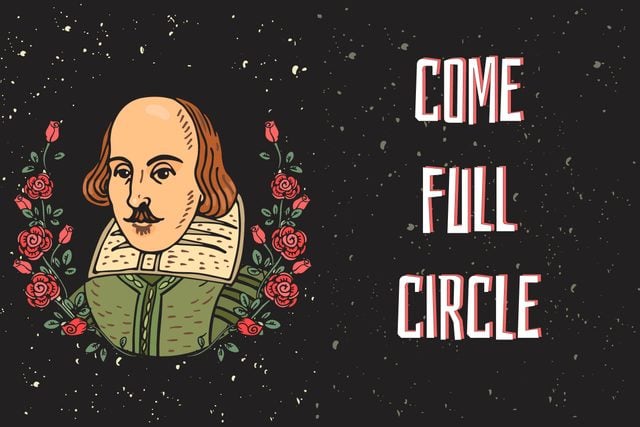
Come full circle

Where it’s from: King Lear, Act 5, Sc 3

The full quote: “The wheel is come full circle; I am here.”

If you’ve ever commented that something has come full circle, now you know you were a Shakespeare-quoting fiend all along. Most agree that this line was first used by Shakespeare, but it’s good to keep in mind that, as Biesel says, “It’s impossible to know for certain with many of these phrases or words, because even if we can say as experts it is the first written record of it in print, it could simply be the earliest we have found so far or simply the first recording of a well known saying.” That recording for us is in Shakespeare’s famous tragedy, where Edmund, who has committed multiple atrocities, rather dryly comments on the wheel coming full circle after being gravely wounded himself. The phrase both then and now means to return to a state like where you began, usually after a series of many major changes that still somehow lead you right back where you were.

4 / 21

22 Everyday Words And Phrases That Were Actually Invented By Shakespeare 4
READER'S DIGEST, GETTY IMAGES

Brave new world

Where it’s from: The Tempest, Act 5, Sc 1

The full quote: “How beauteous mankind is! O, brave new world That has such people in ‘t!”

London itself in Shakespeare’s time was a sort of brave new world. “You have to understand, the city was exploding with culture and people from all over arriving in the city, and everyone was playing with words and languages,” Biesel notes. Perhaps this vibrant exchange, which fed so much of Shakespeare’s writing, is what was in his mind when he penned Miranda gasping in wonder and joy at her first introduction to people outside her limited circle. The phrase today can echo the same literal meaning of wonder and joy as Miranda or take on the more ironic, dark tone used by Aldous Huxley centuries later, who borrowed the phrase for his book, Brave New World.

5 / 21

22 Everyday Words And Phrases That Were Actually Invented By Shakespeare 5
READER'S DIGEST, GETTY IMAGES

Laughable

Where it’s from: Merchant of Venice, Act 1, Sc 1

The full quote: “Nature hath framed strange fellows in her time: Some that will evermore peep through their eyes
And laugh like parrots at a bagpiper, And other of such vinegar aspect That they’ll not show their teeth in way of smile
Though Nestor swear the jest be laughable.”

When talking about language or words Shakespeare invented, we have to say that one of the truly brilliant things Shakespeare did with language was to change its form. “Even if he was not inventing everything, he was still sort of recreating,” Biesel observes. One of the words we use to this day is “laughable.” While the word and concept of laughter and laughing were long in play by Shakespeare’s time, it is the Bard himself who reformatted the term and gave us the very lovable and easily usable “laughable.” It would be no laughing matter to live in a world we couldn’t sometimes find laughable, so the next time you find yourself saying “that’s laughable” ironically or earnestly, you can thank the bard for yet another gift to modern language.

6 / 21

22 Everyday Words And Phrases That Were Actually Invented By Shakespeare 6
READER'S DIGEST, GETTY IMAGES

Too much of a good thing

Where it’s from: As You Like It, Act 4, Sc 1

The full quote: “Why then, can one desire too much of a good thing?”

You’ve probably heard it said that it is possible to have “too much of a good thing,” but did you know that it can be found in a Shakespeare play? In fact, it’s a line from the delightfully witty cross-dressing rom-com of a Shakespeare play, As You Like It, and comes up when Rosalind, playing a boy playing herself, “pretends” to wed and bants this flirty question at her faux-groom and real-life-crush. The concept of the phrase was around long before Shakespeare’s time and was even translated into English a few decades before this place, but As You Like It is the first written recording we have of the phrase being used originally in English literature. It’s probable, though impossible to say with 100% certainty, that Shakespeare’s incorporation of the phrase into his writing is what launched its popularity and the reason we can enjoy using it today.

7 / 21

22 Everyday Words And Phrases That Were Actually Invented By Shakespeare 7
READER'S DIGEST, GETTY IMAGES

The naked truth

Where it’s from: Love’s Labor’s Lost, Act 5, Sc 2

The full quote: “The naked truth of it is, I have no shirt”

This line comes from Love’s Labor’s Lost, where Armado (a very sincere braggart) is preparing to fight—but announces he will not do so while wearing his shirt. These days, we usually use “the naked truth” as an expression that reveals some sort of disturbing reality or underlying flaw. “The naked truth is used as something you would normally hide away. And Shakespeare’s just using it as a joke,” Biesel laughs. It’s hard not to laugh, thinking of the original use of the phrase, where the naked truth was, in fact, very literal indeed.

8 / 21

22 Everyday Words And Phrases That Were Actually Invented By Shakespeare 8
READER'S DIGEST, GETTY IMAGES

I have not slept one wink

Where it’s from: Cymbeline, Act 3 Sc 4

The full quote: “O gracious lady, Since I received command to do this business I have not slept one wink.”

Not getting a wink of sleep is a turn of phrase more familiar to most than its Shakespeare play of origin, Cymbeline. Typically used to mean someone is either much too agitated or excited to sleep even the tiniest bit, the meaning behind the phrase has remained unchanged since 1610, when the play was published. Its first usage comes when a servant, Pisanio, is under direction from his master to kill the master’s wife. Believing the wife innocent of the accusations against her, Pisanio’s distress over the task keeps him from sleeping. When he confesses this to her, she rather dryly encourages him to get on with the task so he can actually get some sleep, then. (Spoiler: he does not, in fact, follow his instructions and the lady somehow comes out unscathed by the play’s end.)

9 / 21

22 Everyday Words And Phrases That Were Actually Invented By Shakespeare 9
READER'S DIGEST, GETTY IMAGES

The green-eyed monster

Where it’s from: Othello, Act 3, Sc 3

The full quote: “It is the green-eyed monster which doth mock The meat it feeds on.”

Ever experience the pangs of jealousy? Then you can join Shakespeare’s Othello in his painfully miserable “green-eyed monster” club. This is another “modern” phrase that actually originated with Shakespeare several centuries ago. In fact, he played with the idea behind it in an earlier play, The Merchant of Venice, where he refers to “green-eyed jealousy (Act 3, Sc2).” It was a few years later, when he produced Othello, that he evolved his own concept into the “green-eyed monster” phrase we know and use today. One of the additional layers of brilliance around its use in the play is that our epic villain, Iago, uses it when telling Othello to chill out and not be so jealous—all while he was going around behind the scenes doing everything possible to fan the flames of jealousy to a point of consumption and absolute destruction.

10 / 21

22 Everyday Words And Phrases That Were Actually Invented By Shakespeare 10
READER'S DIGEST, GETTY IMAGES

A sorry sight

Where it’s from: Macbeth, Act 2, Sc 2

The full quote: “This is a sorry sight.”

Anytime someone observes that something is a “sorry sight,” they’re practically calling up ghosts from the famous tragedy, Macbeth. We mean it these days as a commentary on something that appears to be anything from generally unfortunate or in a bad condition to positively pitiful or outright wretched. In the play, Macbeth is referring to his own bloodied hands after his murderous night’s work. Fun fact, this phrase not only appears for the first time in this Shakespeare play, but is used twice in a row; first from Macbeth himself and right after from his wife, who essentially throws it back at him and calls him a baby (more or less) for bemoaning his misdeeds.

11 / 21

22 Everyday Words And Phrases That Were Actually Invented By Shakespeare 11
READER'S DIGEST, GETTY IMAGES

Elbow room

Where it’s from: King John, Act 5, Sc 7

The full quote: “Ay, marry, now my soul hath elbow-room.”

The amount (or lack) of elbow room in economy class, especially on airplanes, is a matter of strong contention, as most people don’t really like being so up close or squashed against total strangers. Though airplanes came long after Shakespeare’s time and people preceding him valued their space, too, it is Shakespeare who brought this popular phrase to life. Interestingly, he used the phrase in the play not to talk about bumping against people, but more along the lines of breathing room, or space for the dying titular king’s soul to be free. If you ever want an easy way to remember that the phrase comes from King John, think of King’ John’s snake advisor, Sir Hiss, in Disney’s animated Robin Hood, who somehow managed to have elbows and cross his arms despite being a snake.

12 / 21

22 Everyday Words And Phrases That Were Actually Invented By Shakespeare 12
READER'S DIGEST, GETTY IMAGES

Break the ice

Where it’s from: The Taming of the Shrew, Act 1, Sc 2

The full quote: “If it be so, sir, that you are the man Must stead us all, and me amongst the rest, And if you break the ice and do this feat, Achieve the elder, set the younger free For our access, whose hap shall be to have her Will not so graceless be to be ingrate.”

This popular expression has not changed much at all since Shakespeare first launched it into popularity with his rather savage comedy, The Taming of the Shrew. From the very beginning til now, the phrase is all about breaking through that “awkward, initial social tension,” as Shakespeare’s Birthplace Trust describes it. We use “icebreakers” in professional development activities and networking events all the time these days—and even find ways to use them in our dating lives. In fact, the phrase is used because a bunch of guys are all interested in a girl, but to get to her, they have to get around her older sister, first, and that sister was ice cold to all their attempts. The Taming of the Shrew inspired the more recent rom-com, 1999’s 10 Things I Hate About You. Who knew dating and love lives could have so much in common across centuries?

13 / 21

22 Everyday Words And Phrases That Were Actually Invented By Shakespeare 13
READER'S DIGEST, GETTY IMAGES

Wear my heart on my sleeve

Where it’s from: Othello, Act 1, Sc 1

The full quote: “For when my outward action doth demonstrate The native act and figure of my heart In complement extern, ’tis not long after But I will wear my heart upon my sleeve For daws to peck at.”

Yes, you have Shakespeare to thank for this common lyric in angsty pop love songs today, and it’s another goodie from the tragic Othello. But instead of using it in the context of singing about a teenage crush, the villainous Iago uses the line to differentiate between himself and Othello. Reading the line, I can practically see the manipulative Iago shudder at the thought of being so transparent as to wear his heart on his sleeve rather than maintaining his usual flawless mask of duplicity.

14 / 21

22 Everyday Words And Phrases That Were Actually Invented By Shakespeare 14
READER'S DIGEST, GETTY IMAGES

The world is my oyster

Where it’s from: The Merry Wives of Windsor, Act 2, Sc 2

The full quote: “Why then, the world’s mine oyster, which I with sword will open.”

Today, whether we say “the world is my oyster” or “the world was their oyster,” it was Shakespeare who said it first. According to Shakespeare’s Birthplace Trust and scholars to date, it was first used in the comedy, The Merry Wives of Windsor, sometime between 1597 and 1601. From then til now, from “mine” to “my,” the meaning of the phrase has stayed the same: if the world is your oyster, then you have all the possibilities ahead of you and can achieve whatever you want in life.

15 / 21

22 Everyday Words And Phrases That Were Actually Invented By Shakespeare 15
READER'S DIGEST, GETTY IMAGES

Love is blind

Where it’s from: The Merchant of Venice, Act 2, Sc 6

The full quote: “But love is blind, and lovers cannot see The pretty follies that themselves commit, For if they could, Cupid himself would blush To see me thus transformèd to a boy.”

This all-too-true expression had the same meaning in Shakespeare’s day as it does today, though its context in The Merchant of Venice involves a classic scenario in his work. Lovers Jessica and Lorenzo plan to elope, so Jessica disguises herself as a boy to avoid suspicion. She finds her get-up rather embarrassing, but fortunately, love is blind and Lorenzo couldn’t care less. Of course, one of the funny aspects of this line is easy to miss today if you aren’t already in the know, because back when this originally played at Shakespeare’s Globe, the girl parts were never played by women in the first place, but boys!

16 / 21

22 Everyday Words And Phrases That Were Actually Invented By Shakespeare 16
READER'S DIGEST, GETTY IMAGES

Wild goose chase

Where it’s from: Romeo & Juliet, Act 2, Sc 4

The full quote: “Nay, if our wits run the wild-goose chase, I am done, for thou hast more of the wild goose in one of thy wits than, I am sure, I have in my whole five.”

If you’ve ever been annoyed, outraged or duped by the empty outcomes of a “wild goose chase,” you’re in classic (and admittedly also tragic) company. In Romeo and Juliet, that iconic star-crossed romance, the hero’s bestie complains of being dragged along on Romeo’s “wild goose chase” of an attempt to wed the love of his life, who just so happens to be the beloved, beautiful daughter of a rivaling clan. Considering the terrible ending of Romeo’s problematic pursuit of young love, his friend Mercutio had a solid point.

17 / 21

22 Everyday Words And Phrases That Were Actually Invented By Shakespeare 17
READER'S DIGEST, GETTY IMAGES

Melted into thin air

Where it’s from: The Tempest, Act 4, Sc 1

The full quote: “These our actors, As I foretold you, were all spirits and Are melted into air, into thin air;
And like the baseless fabric of this vision, The cloud-capped towers, the gorgeous palaces, The solemn temples, the great globe itself, Yea, all which it inherit, shall dissolve, And, like this insubstantial pageant faded, Leave not a rack behind.”

I apparently loved Shakespeare long before I knew it, because I have loved using the line, “and then, she melted into thin air” as an ending to spooky stories for as far back as I can recall. It’s just so incredibly mysterious. And indeed, that is exactly how Shakespeare intended it, with its debut scene in The Tempest revolving around a moment when all the characters seemingly vanish without a trace—a great moment for stage dramatics. An interesting fact about this phrase, though, is that the actual version we use today of “melted into thin air” does not appear in that exact form in Shakespeare. Rather, a prequel to it can be found in Othello, where a clown dramatically tells a musician, “Then put up your pipes in your bag, for I’ll away. Go, vanish into air, away!” It was seven more years before Shakespeare tried it out again in The Tempest in the form and place that scholars consider the phrase’s origins, when Prospero says all the spirits “are melted in air, into thin air.”

18 / 21

22 Everyday Words And Phrases That Were Actually Invented By Shakespeare 18
READER'S DIGEST, GETTY IMAGES

It’s Greek to me

Where it’s from: Julius Caesar, Act 1, Sc 2

The full quote: “But for mine own part, it was Greek to me.”

Why is it that so many people say, “It’s Greek to me” when looking at or hearing something that is completely unintelligible to them? Well, this is another case of a Shakespearean catchphrase gone viral. This phrase comes directly from the famous Julius Caesar play, and specifically, from where one of the characters, Casca, is essentially making a crack at Cicero, who was literally speaking Greek instead of Latin. However, while the phrase as we know it originates with the play, the sentiment of the phrase had already been around for ages. You can see many expressions of it in Medieval literature, where the Latin statement, “Graecum est; non legitur,” essentially meaning “It’s Greek and not intelligible,” was often used by monks who were translating old Greek documents but didn’t understand something in the original script. Though even Shakespeare used the phrase as we know it quite literally, it packed a pretty quippy little zing in its usage that probably made it so catching to the public—and nowadays, we use it indiscriminately as a way to say something is obscure to us.

19 / 21

22 Everyday Words And Phrases That Were Actually Invented By Shakespeare 19
READER'S DIGEST, GETTY IMAGES

Half-blooded

Where it’s from: King Lear, Act 5, Sc 3

The full quote: “Half-blooded fellow, yes.”

Would Harry Potter and the Half-Blood Prince exist without Shakespeare? The answer is no, because it is Shakespeare himself who is first credited with coining the term “half-blood.” Suprise! It’s fun when famous bodies of literature are connected in some way. Shakespeare set the term to mean “having only one noble parent” or being a bastard, a definition which has largely stuck with the term in the years since. It can also be seen as “diluted blood” and is almost always used in a derogatory fashion as a put-down, just like how the character Albany used it as a slight against the illegitimate Edmund in King Lear.

20 / 21

22 Everyday Words And Phrases That Were Actually Invented By Shakespeare 20
READER'S DIGEST, GETTY IMAGES

The game is afoot

Where it’s from: Henry V, Act 3, Sc 1

The full quote: “The game’s afoot.”

If you’ve heard this phrase before, chances are you assumed it came from Sir Arthur Conan Doyle, whose epically famous Sherlock Holmes utters the signature expression whenever launching into investigator mode. In fact, the line predates this fictional detective and has been traced right back to Shakespeare’s introduction of it in Henry V, where the king himself uses it in his well-known “Once more unto the breach” speech to rally his troops. Not much has changed in meaning over the centuries, but this is one instance where the Bard’s original usage of the phrase didn’t result in instant popularisation of it, as it took Conan Doyle borrowing the phrase for Sherlock Holmes to bring it to its present global fame.

21 / 21

22 Everyday Words And Phrases That Were Actually Invented By Shakespeare
BRIAN HAGIWARA/GETTY IMAGES

Misattributions of  “Shakespearean” quotes

There are so many incorrectly attributed quotes out there on memes and merchandise alike that Tumblr has a whole thread on them. One Biesel particularly finds terrible is the saying, “When I saw you, I fell in love and you smiled because you knew. It’s supposedly a line from Much Ado About Nothing, but it’s ridiculous. Is it Shakespeare? No, it’s not Shakespeare at all.”

Sometimes, the misattribution of words Shakespeare invented is harder to identify because reliable sources like the Oxford English Dictionary have tied the word or phrase to Shakespeare. “It is really important to understand that the attribution there is all about the earliest known record of the word (which of course, has to be the earliest found print usage of it),” Biesel explains. Some of the words currently attributed to Shakespeare could be bedrotting in an ancient manual in a forgotten vault of a crumbling building somewhere, for example, and the earliest record currently known is Shakespeare’s play. So a word that was attributed to Shakespeare up to quite recently could be found, eventually, to have been an incorrect neologism, and that can take time to adjust and update the records everywhere.

Ammon Shea, author of Bad English: A History of Linguistic Aggravation and Reading the OED: One Man, One Year, 21,730 Pages, has written about how the OED used to have over 2,000 words attributed to Shakespeare. That number dropped significantly to just above 1,500 according to Shea. The Shakespeare’s Birthplace Trust has said Shakespeare’s “works provide the first recorded use of over 1,700 words in the English language,” though they are careful to note that is simply the first recorded (print) use in English.

About the expert

  • Clara Biesel is a Shakespearean at Southern Connecticut State University with a PhD in English from the University of Minnesota. She completed her BA in English and Music at Houghton College and holds an MLitt and an MFA from Mary Baldwin University in Shakespeare and Performance in collaboration with the American Shakespeare Center in Staunton, Virginia. Her research interests include questions of certainty in the technologies of text, both in the anxieties of print and nostalgia of manuscript, particularly how these cultural states are embodied in and through early modern English drama.

Sources: