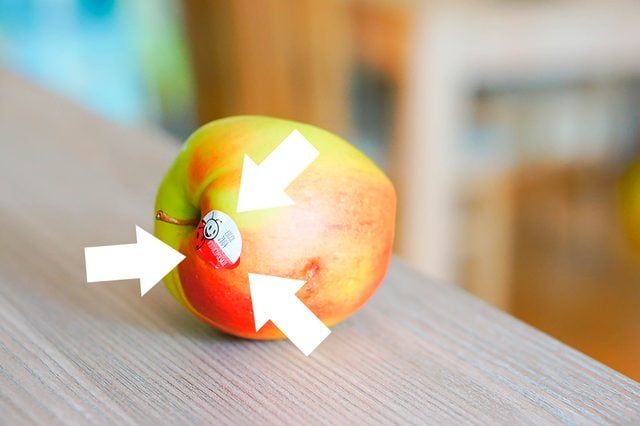
Behind every stubborn little sticker is a secret system of fruit facts waiting to be peeled back
Here’s What Those Numbers on Fruit Stickers Really Mean
During my broke college days, I worked as a grocery checker. Surprisingly, it was a job I really enjoyed—I got to talk to all kinds of people and marvel at the weird things they bought. (Like the guy who regularly purchased sardines, whipped cream and a single potato. Sir, are you OK?) But one part of the job that wasn’t quite as fun? Memorizing all the PLU codes—you know, the numbers on those stubborn little produce stickers. So I spent a lot of time squinting at apples, muttering “4016” under my breath, and silently resenting the very existence of fruit stickers.
But while I had to memorize them, I was never quite sure what was the meaning of the fruit codes on those stickers. Fruit stickers—those clingy little guys that always end up stuck to your fingers or mysteriously reappear on your kitchen counter three days later—are one of life’s oddly specific mysteries. Are they secret government codes? The fruit mafia’s signature? The expiration date of a banana’s hopes and dreams?
I asked M. Scott Howarth, PhD., the Director of Research and Development at Sinclair, a company that prints billions of these stickers every year. He literally studies these things for a living (yes, that’s a job!), and he assured me there’s nothing shady going on here. “Fruit stickers serve multiple practical purposes for consumers, retailers, and everyone in the supply chain,” he says. “These little stickers actually provide a huge amount of product information.” Basically, those numbers are the produce world’s version of a name tag, nutritional label, and boarding pass all rolled into one tiny sticker.
And there’s a surprising amount of drama packed into those four or five digits. Once you know how to decode them, with the help of Howarth, you may never look at your 4011 bananas the same way again. Read on to peel back the mystery of the numbers on fruit stickers.
Get Reader’s Digest‘s Read Up newsletter for more food facts, tech, travel and humor all week long.
Why do fruits have those little stickers?
Fruit stickers—officially called PLU (Price Look Up) codes—aren’t just there to decorate your store snack or give your kid something to stick on their forehead. There are over 1,400 unique PLU codes assigned to various fruits and vegetables and they “provide information about the fruit, like the country of origin, variety, quality, and growing method via PLUs,” Howarth explains. They help grocery stores identify, price and track produce inventory.

But they also help you. “Using fruit stickers allows consumers to make informed choices,” Howarth says. It’s how you can tell if that apple is organic, where your mango came from or whether that avocado is the good kind (OK, they’re all the good kind).
Here’s what these humble little fruit codes actually do:
They identify the type and variety
Not all apples are created equal—some are Gala, some are Fuji and some are those mysterious red “delicious” ones that are anything but delicious when they get mushy. The sticker tells the cashier (and you) exactly what you’re biting into.
They tell you how it was grown
Was your produce conventionally grown? Organically farmed? Genetically modified? Organic fruit numbers use a different numbering convention. The PLU code reveals all—like the Sorting Hat for fruit.
They make checkout faster
Instead of typing in “medium suspiciously soft pear,” cashiers can just scan the sticker or type in the PLU, which brings up the price and product info instantly.
They help reduce packaging waste
Instead of wrapping every piece of fruit in plastic (please no), the sticker does the job of labeling. Some are even certified compostable, Howarth says, meaning they can be tossed in your compost bin—not just your conscience.
They support food safety
If there’s ever a food recall or quality issue, those little stickers aren’t just for show—they’re also a key part of the produce supply chain. “Fruit stickers provide traceability, including batch or lot codes that can be used to support quality control and internal tracking for growers and distributors,” Howarth says. This means the store can notify you of any potential problems before you slice open that melon.
What do the numbers on fruit stickers mean?

Here’s where the real fruit code sleuthing begins. PLU codes are either four or five digits long, and the way they start tells you a lot about the produce’s backstory.
Four-digit codes that start with a 3 or 4: conventionally grown produce
These are your standard, pesticide-using, industrial-farmed fruits. Nothing shady, just your average grocery store apple.
Example: 4011 bananas. Yep, this is the world’s most famous fruit code.
Five-digit codes that start with a 9: organically grown produce
If the code starts with a 9, you’re looking at organically grown produce.
Example: A conventionally grown Fuji apple is 4129. An organic Fuji? 94129. Boom—instant upgrade.
Five-digit codes that start with an 8: genetically modified produce
This one’s a bit controversial. While an “8XXXX” code used to signify genetically modified (GMO) produce, it’s rarely used now because (surprise!) no one wanted to buy it. So you probably won’t see this one in your local Kroger. But if you do, note that there’s no scientific evidence that GMOs are harmful.
Example: 84011 would be the GMO version of a banana…if anyone used it, which they don’t. So if you’ve been avoiding fruit with a PLU that starts with 8—congrats, you’ve been dodging a ghost.
What are some common PLU codes to look for?
Here are some sticker numbers for the most popular fruit items purchased in 2023, according to the International Fresh Produce Association. (It’s been 20 years since I worked in a grocery store, and I was shocked at how many of these I still remember!)
- 4011: Bananas
- 3087: Strawberries
- 4133: Gala apples
- 4023: Red seedless grapes
- 4032: Watermelon
- 4225: Avocado (Haas)
- 4055: Mandarin orange
- 3107: Navel orange
- 4037: Peach
And remember, these numbers can vary slightly in the store. For instance, apple PLUs change by variety and a large apple will have a different number than a small. For organic, add a 9 before the regular PLU.
Who came up with this system?
Grocery stores started informally using PLU codes in the U.S. in 1990 as a way to help stores efficiently ring up bulk produce. Before this, pricing apples required either a psychic cashier or a lot of handwritten signs. In 2001, the International Federation for Produce Standards (IFPS) stepped in to standardize the system globally. Today, the IFPS is basically the United Nations of fruit stickers, making sure a banana is a 4011 no matter where you are in the world.
Fun fact: In a twist worthy of a made-for-TV grocery docuseries, produce companies at one point considered laser etching the information directly onto fruit skins, like a tiny fruit tattoo. The method works (and is still sometimes used), but it’s more expensive and doesn’t hold up well on soft or irregularly shaped produce. So the sticker survived to cling another day.
Are these numbers required?
Nope. PLU codes are completely voluntary. But most retailers use them anyway. “Use is driven by the retail industry’s need for efficiency in both the store’s backend and point of sale, making check-out and inventory control easier, faster, and more accurate,” Howarth says.
You’ll see them on loose, bulk produce like apples, bananas, or avocados. You won’t see them on bagged salads, frozen veggies, or produce sold in pre-packed trays. So if your fruit comes in a plastic clamshell—no sticker for you.
Are these produce stickers edible?
Short answer: No. Long answer: Also, no, but if you accidentally eat one, you’ll survive.
“Produce stickers must meet strict food-safety requirements in all global markets,” Howarth says. So while they’re not designed to be eaten, they’re not toxic either. This is great news for parents everywhere.
Plus, innovations like compostable labels are here to save the planet (and your intestines). “For example, we’ve developed compostable labels like the T55,” Howarth notes. These break down in composting systems, just like your banana peels. Full circle!
Do vegetables also have these produce stickers?
Yes! If your potato, bell pepper, or zucchini is sold loose, chances are it’s wearing a tiny sticky tuxedo too. The same rules apply: four digits for conventional, five with a 9 for organic, and five with an 8 for…oh boy, let’s not reignite this argument.
Produce stickers may be small, but they pack a juicy punch of information. With just a glance at a PLU code, you can know how your produce was grown, where it came from, and whether you’re about to accidentally eat a genetically modified cantaloupe (spoiler: probably not). And hey, now you can impress your friends at your next farmers market trip by casually identifying 4011 bananas like it’s no big deal.
About the expert
|
Why trust us
At Reader’s Digest, we’re committed to producing high-quality content by writers with expertise and experience in their field in consultation with relevant, qualified experts. We rely on reputable primary sources, including government and professional organizations and academic institutions as well as our writers’ personal experiences where appropriate. For this piece on grocery store cart design and theft prevention, Charlotte Hilton Andersen tapped her experience as a longtime journalist who specializes in common curiosities, etiquette and communication for Reader’s Digest. We verify all facts and data, back them with credible sourcing and revisit them over time to ensure they remain accurate and up to date. Read more about our team, our contributors and our editorial policies.
Sources:
- M. Scott Howarth, PhD, Director of Research and Development at Sinclair, email interview August 19, 2025.
- International Fresh Produce Association: “Top 20 Fruits and Vegetables Sold in the U.S.”
- International Federation for Produce Standards: “PLU codes”