11 Ways Your Hotel Room Could Be Making You Sick

Lisa Lombardi

By Lisa Lombardi

Updated on Jul. 30, 2025

Do you always get a stuffy nose in hotel rooms? Return home with a cough, GI bug or funky rash? Here's how to avoid the dreaded hotel sickness syndrome.

Don’t get sick on your trip!

I’m not wild about other people’s germs, so every time our family checks into a hotel, I whip out my disinfecting wipes and transform the room into a place where you could safely perform minor surgery. My husband and kids roll their eyes, but who wants to have a stuffy nose in the hotel room or spend your precious vacation week hacking up a lung or stuffing tissues into a beach tote?

Besides, as a health reporter, I closely follow all the steps hotel chains and cruise lines take to prevent outbreaks of bacterial pneumonia, cold, flu and COVID. But now that we’re in 2025, I couldn’t help but wonder: Am I overreacting … or is it still easy to get sick from a hotel stay?

Spoiler alert: I’m not overreacting. Hotel rooms are petri dishes, confirms microbiologist Charles Gerba, PhD, a professor of virology at the University of Arizona. If you think about it, you’re sharing those tight quarters with tons of previous guests (and their kids … and possibly their dog). “Everything in a hotel has been touched by a high number of people,” and all those “high-touch surfaces” can spread illness, Gerba explains.

If you bargain-shop for lodging, you’re even more likely to pick up something from your stay. “We studied a number of hotels and found the less you pay, the more germs you’re sleeping with in a room,” Gerba says. That said, microbiologists have found microbes lurking everywhere from one-star hovels to five-star resorts.

To find out where germs tend to hang out in hotel rooms and how to travel without coming home sick, we asked Gerba, microbiologist Jason Tetro, and Brian Labus, PhD, an associate professor of epidemiology and biostatistics at the University of Nevada, Las Vegas, to walk us through the hotel-room habits that can put you at risk. Read on to find out where the germiest hotel hot spots are, so you can avoid getting sick during your trip or bringing a nasty bug home with you.

Get Reader’s Digest’s Read Up newsletter for more travel, tech, cleaning, humor and fun facts all week long.

1 / 10
 Woman Is Holding A Television Remote Control
Karl Tapales/Getty Images

You grab the remote

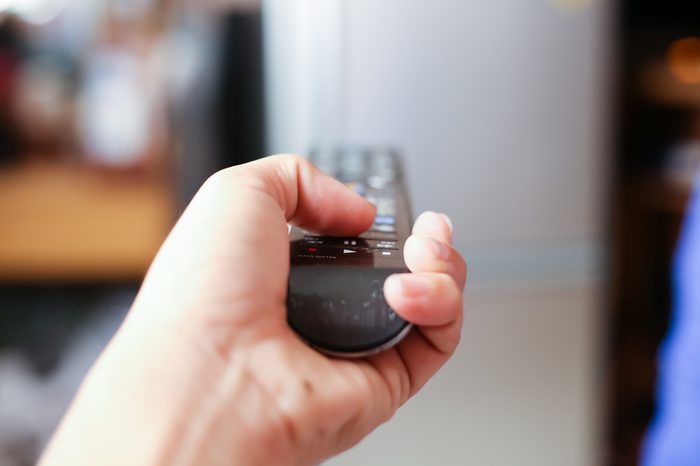
The TV remote control is “the germiest thing in the hotel room,” Gerba says. It’s a high-touch item, meaning it’s been pawed by many guests, and it doesn’t get cleaned well, due to its bumpy design. “They’re really bad because it’s hard to disinfect between the buttons,” Gerba says.

Just how icky is it? It’s crawling with bacteria and viruses. “The TV remote has a few hundred microbes per square inch,” Tetro says.

What to do: Before you flip channels, wipe the remote with a disinfecting wipe. If you forgot to pack them, “knuckle up,” as Gerba does. “I knuckle up the remotes and elevator buttons,” he adds. Then be sure to use hand sanitizer or wash your hands.

My hack is to pack quart-size baggies, grab the remote with a paper towel, drop it into the plastic pouch and zip it up. (Note: Your family will complain that it’s awkward to use, but it still works.)

Some hotels have switched to smart remotes: flat-surfaced ones that are much easier for the chain to wipe down (hopefully with a proper disinfectant). You can research ahead and book somewhere that offers this more-hygienic option.

2 / 10
Woman Sleeping In Her Bed
Witthaya Prasongsin/Getty Images

You cozy up with the comforter

Have you ever seen those TV news reports where they shine a black light on a hotel bedspread to check for semen, and the bedding lights up like a planetarium ceiling? As it turns out, bodily fluids aren’t the only nasty things you could come in contact with when you touch these germy hot spots in your hotel room. A study published in the Journal of Environmental Health tested surfaces in high-priced, midpriced and inexpensive Canadian hotels and found high bacteria counts on comforters across the board.

While, in general, surfaces in higher-end rooms were cleaner than those in lower-end rooms, the comforters proved to be an exception. Some of the high-end hotels had high bacteria counts on comforters too.

If the bedspread is stripped off the bed and washed in hot water with commercial detergent every time, this isn’t a worry, but the trouble is that some chains don’t swap out the bedspreads between guests. Gross, right?

What to do: Ask about a hotel’s cleaning protocols for bedding before you book, our experts advise. If you can’t confirm that the comforter is thoroughly laundered between hotel visitors, remove it and just sleep under the sheets. Whatever you do, don’t reach for that blanket buried in the closet, which is even less likely to have been washed than the comforter.

3 / 10

Cute Baby Girl Crawling On The Floor
kajakiki/Getty Images

You let your toddler crawl on the rug

When it comes to germs, “hotel carpets are awful,” says Gerba. In fact, he adds, there have been norovirus outbreaks in hotels traced to the carpet. In two cases, someone threw up in the carpeted hallway, housekeeping cleaned it up and vacuumed over the area, then they inadvertently spread norovirus to guest rooms via the vacuum. “When you vacuum, you create a cloud of bacteria and viruses,” Gerba explains. “Norovirus was traced to the wheels of the vacuum.”

What to do: There isn’t much you can do to remedy this problem. As much as possible, avoid sitting directly on the carpet. If you have a little one who crawls around, spread a large play mat or quilt that you bring from home.

And if you happen to stroll out of your room and housekeeping is vacuuming the hall, duck back into your room until the (germ-ridden) dust stops flying. “You don’t want to be in that hallway,” Gerba warns.

4 / 10

A Hand Is Reaching For A Switch To Turn On A Bedside Lamp
Sergey Dolgikh/Getty Images

You flip on the light

“The light switch in a hotel room has several hundred microbes per square inch,” says Tetro. The study that examined hotel rooms at different price points in Canada found bedside lamps harbor dangerous MRSA (Methicillin-resistant Staphylococcus aureus) bacteria, particularly the lights in lower-end chains.

What to do: Before you reach for the light switch, wipe it with a disinfecting wipe. It may seem a little extra, we know, but it’s better than touching it and catching the common cold … or worse.

5 / 10

Refillable Shower Gel In Bathroom
MartinPrescott/Getty Images

You use the refillable shower gel

The eco-friendly refillable body soap may be green in more ways than one: It’s brimming with bacteria. A 2019 study led by Gerba tested refillable shampoos, conditioners, body lotions and shower gel in 40 hotel rooms across 20 hotels and found 100% bacterial contamination, with 76% having more than 1,000 colony-forming units per gram (CFU per gram). They found E. coli and pseudomonas, a type of bacteria that causes skin and eye infections. “If you have contact lenses and you use the refillable soap, you could get an eye infection,” Gerba says.

This setup is dicey because every time the cleaning staff tops off the soaps and shampoos, they introduce germs. “The products have a little bit of an antimicrobial in there, but eventually it degrades so you get millions of bacteria,” Gerba warns.

What to do: Find out before you go away if your hotel uses these refillable containers, and if so, pack travel-size products. “I happen to be so paranoid, I bring my own soap and shampoo with me,” Gerba says.

6 / 10
Bathroom Vanity With Wooden Countertop
Mystockimages/Getty Images

You leave your toothbrush on the bathroom counter

That hotel bathroom may smell like rosemary-mint goodness, but make no mistake—it’s full of E. coli. If your toothbrush sits anywhere near the toilet, Gerba warns, “whatever you flush in a toilet, you’re gonna be brushing your teeth with.” That includes fecal matter from previous guests. Lovely.

Alas, the bathroom counter isn’t much better, according to Tetro, so don’t even think about leaving your toothbrush out on the counter. While hotels generally clean this surface, it will still get doused with what Gerba calls “the toilet sneeze.” A 2024 study he led investigated whether shutting the toilet lid in commercial and home bathrooms would prevent bacteria from spraying around the room. Spoiler alert: Even when the lid is down, microbes spray everywhere.

What to do: “If you keep the toothbrush close to the toilet, I would really cover it,” Gerba says. And don’t leave makeup and other personal-care items out in the open within a three-foot zone of the bowl because that’s the danger contamination zone. Another way to avoid this gross problem is to book a hotel that has the commode tucked away in a separate little room within the bathroom. Great for privacy … and E. coli containment.

7 / 10

Woman Is Sitting On Her Bed In Her Hotel Room Using The Phone To Order Room Service
SolStock/Getty Images

You order room service

The room-service menu looks innocent enough, but it’s a germapolooza. Items that are touched often but not considered to be dirty have a higher number of germs, Tetro says. “Studies have examined this and shown that some of the germiest culprits are the ones we wouldn’t think of cleaning, like the room-service menu and the ice bucket,” he adds.

Even if the hotel wipes down that menu between guests, they might not be using anything more than a surface cleaner, which won’t remove the nasty germs, experts say.

What to do: If you have a hankering for a late-night burger or need to have your eggs in the room, peruse the menu, and then wash your hands with soap and/or use hand sanitizer. “I always pack hand sanitizer,” Gerba says.

8 / 10
Telephone In The Hotel Room On A Table
Andrey Sayfutdinov/Getty Images

You call the front desk using the landline

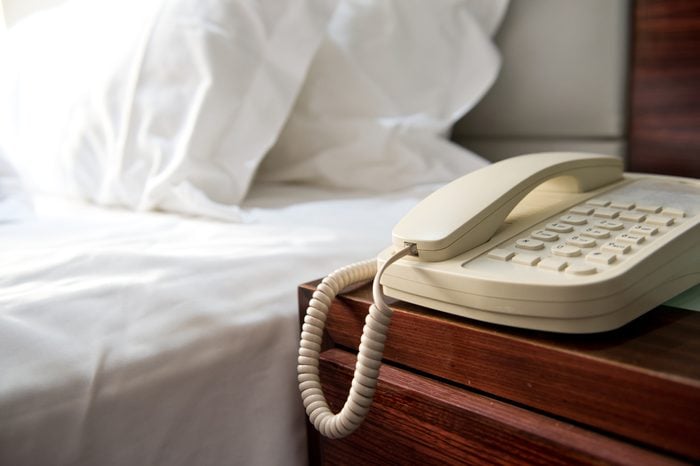
How do you know the touch-tone phone on the bedside table is a high-touch item? It has touch right in the name! Gerba’s research found that hotel-room phones are teeming with germs. “Nobody cleans or disinfects the phone,” he says. “So if you use it, you’re gonna be talking dirty because there’s no way around it.”

What to do: Use your cellphone. Yes, even just to call the concierge, spa or room service. When you check in, ask for the direct numbers to all the key hotel departments, and don’t give that gunky landline another glance.

9 / 10

Close Up On Air Conditioner Indoor
xphotoz/Getty Images

You turn on the AC

If the hotel air conditioning makes you sneeze or causes your sinuses to throb, you’re not alone. The probable culprit is mold spores, Tetro says.

You’re more likely to have mold spewing from the AC if you’re staying near the water or at a low latitude (aka a destination close to the equator), according to a 2020 study published in the American Society for Microbiology’s mSystems journal. The researchers collected samples from hotels in 19 countries and found that Aspergillus mold was much more common in hotels in low latitudes, such as Thailand, than in high-latitude spots. Aspergillus can cause inflammatory problems and allergies, with symptoms including coughs and headaches (aka hotel sickness). Improperly maintained ACs can make a mold situation worse, the researchers noted.

As it turns out, you’re not home free if you vacation up north: Mid- and high-latitude hotels were more likely to have penicillium, a type of mold that commonly triggers allergy and asthma symptoms, including shortness of breath, according to the American Academy of Allergy, Asthma & Immunology.

What to do: If you don’t want to have a stuffy nose in your hotel room (or a full-blown allergy attack), “use your sense of smell,” Tetro recommends. “We are very good at detecting the microbial volatile organic compounds (mVOCs) that are emitted by these mold organisms.”

If you crank your hotel AC and smell that musty funk, that’s a sign the hotel room is more than just dusty, so ask to be switched to another room. Since swapping isn’t always an option, it’s wise to pack a compact air purifier with a HEPA filter—which can remove dust mites and mold spores from the room—especially if you’re visiting a damp climate.

10 / 10
Silver Stainless Steel Ice Bucket Two Glasses And Tray In Hotel Room
Alla Machutt/Getty Images

You fill your ice bucket and have your drink on the rocks

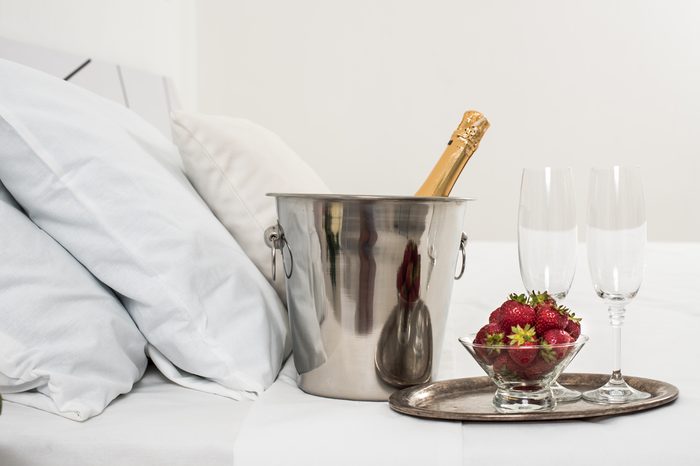
The ice bucket is one of the least-cleaned items in the room, Tetro says. You really don’t want to know why this fact matters, but we’re going to tell you anyway: Other guests may have used the vessel for more than storing ice. There have been hotel norovirus outbreaks traced to an ice bucket that was puked in (oh, gross). “If people have to throw up, ice buckets are one of the only things they can easily reach for in a hotel room,” says Labus. “Norovirus can survive on hard surfaces for up to a month, and ice buckets are not regularly sanitized.”

Not to mention, ice buckets can carry the one thing germs love: water. “Even if it is frozen, the microbes can hitch a ride and get into you,” Tetro says.

What you can do: If you have to have that drink on the rocks, make sure your bucket has a disposable plastic liner, Labus says. If it doesn’t, call down to the front desk … using your own (not-so-germy) cellphone, of course!

About the experts

  • Charles Gerba, PhD, is a professor of virology at the University of Arizona and a specialist in detecting microbes. His research has been published in major scientific journals.
  • Jason Tetro is a microbiologist and the author of The Germ Code and The Germ Files. He is also the host of the Super Awesome Science Show podcast.
  • Brian Labus, PhD, MPH, is an associate professor of epidemiology and biostatistics at the School of Public Health at the University of Nevada, Las Vegas. His research specialties include communicable disease surveillance and outbreak infection and response.

Why trust us

Reader’s Digest has published hundreds of travel stories that help readers explore the world safely, easily and affordably. We regularly cover topics such as the best places to visit (and the best times to visit them), tips and tricks to zoom through airport security, flight-attendant secrets, hotel-room hacks and more. We’re committed to producing high-quality content by writers with expertise and experience in their field in consultation with relevant, qualified experts. We rely on reputable primary sources, including government and professional organizations and academic institutions as well as our writers’ personal experiences where appropriate. For this story on getting a stuffy nose in your hotel room and other sicknesses, Lisa Lombardi tapped her experience as a longtime health reporter and the author of What the Yuck?! The Freaky & Fabulous Truth About Your Body. We verify all facts and data, back them with credible sourcing and revisit them over time to ensure they remain accurate and up to date. Read more about our team, our contributors and our editorial policies.

Sources:

  • Charles Gerba, PhD, professor of virology at the University of Arizona; phone interview, July 17, 2025
  • Jason Tetro, microbiologist, author of The Germ Code and The Germ Files, and host of the Super Awesome Science Show podcast; email interview, July 18, 2025
  • Brian Labus, PhD, MPH, associate professor of epidemiology and biostatistics at the School of Public Health at the University of Nevada, Las Vegas; email interview, July 8, 2025
  • Journal of Environmental Health: “Sanitary Status and Incidence of Methicillin-Resistant Staphylococcus aureus and Clostridium difficile Within Canadian Hotel Rooms”
  • Green Lodging News: “Research Conducted for Clean the World: Bacterial Contamination Common in Refillable Dispensers”
  • American Journal of Infection Control: “Impacts of lid closure during toilet flushing and of toilet bowl cleaning on viral contamination of surfaces in United States restrooms”
  • American Society for Microbiology: “How Viruses Spread Indoors and What to Do About It”
  • mSystems: “Continental-Scale Microbiome Study Reveals Different Environmental Characteristics Determining Microbial Richness, Composition, and Quantity in Hotel Rooms”
  • American Academy of Allergy, Asthma & Immunology: “Mold Allergy”