


The Slave in the Garage
Updated: Aug. 20, 2021





Sold by her parents and smuggled into America, one young girl did a family's dirty work for two years. Then help arrived.
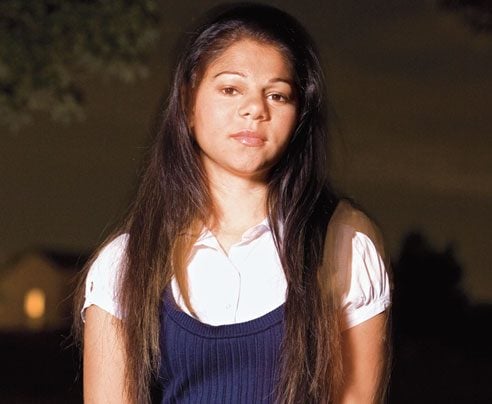
When Shyima Hall arrived in the U.S. as a slave, “I thought this would be my life forever.”
Like a typical teen, Shyima Hall forgets to make her bed and groans when it’s time to do her two chores—vacuuming the floor and cleaning the fishbowl. In the Orange County, California, home she shares with her adoptive parents and five brothers and sisters, the petite 18-year-old lounges on the couch, talking on her cell phone. She wears low-rise jeans, and her nails are painted pink. Last May she went to her prom in a silky gown, her long dark hair worn up with a gardenia. She juggles a packed schedule—part-time job, homework, weekend camp—as if she’s making up for lost time. And she is. A year ago Shyima, who was born in Alexandria, Egypt, closed a chapter in her life she wishes had never been written. It began in 2000, when her impoverished parents sold her to a wealthy couple in Cairo. When the pair moved to the United States, they arranged for the ten-year-old to be brought illegally into the country, where she worked, day and night, in the family’s posh home.
According to the U.S. Department of Health and Human Services, human trafficking is now the fastest-growing criminal industry in the world. As many as 800,000 people are trafficked across international borders annually; the United States is a popular destination, with as many as 17,500 people brought in each year and exploited for sex or labor. Shyima, no stranger to hardship, fell into the latter category. One of 11 children born to desperately poor parents, she grew up in a small one-bathroom house shared by three families. She and her parents and siblings slept in one room on blankets laid out on the floor. Her father was often gone for weeks at a time. “When he was home,” says Shyima, “he beat us.”
She’d never been to school, and her prospects were bleak. Still, Shyima wasn’t without hope. “There was happiness there,” she told a courtroom years later. “I had people that cared for me.”
When she was eight, she went to live with Abdel-Nasser Youssef Ibrahim and his wife, Amal Ahmed Ewis-Abd Motelib, then in their 30s. Shyima’s older sister had worked as a maid for them, but the couple fired her, claiming she’d stolen cash. As part of a deal the couple made with her still-destitute parents, Shyima was forced to replace her.
Two years later, Ibrahim and Motelib decided to move with their five children to the United States to start an import-export business. Shyima didn’t want to go. Ibrahim, she says today, “told me I had no choice in the matter.” She remembers standing outside the kitchen, overhearing her employers talk with her parents. “I heard them negotiate, and then my parents gave me away for $30 a month to these people,” she says.
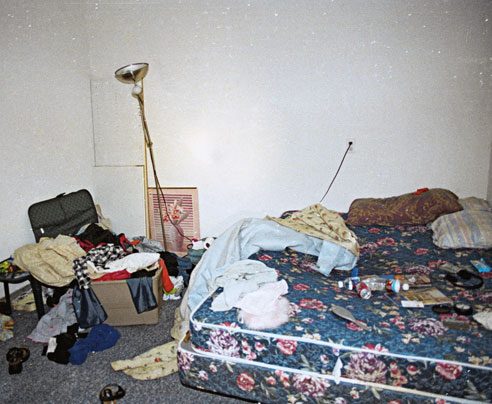
Shyima slept in this windowless room in the garage.
Shyima was brought into the United States on an illegally obtained six-month visitor’s visa and settled into the couple’s two-story Mediterranean-style house in a gated community in Irvine. When she wasn’t working, she was banished to an 8-by-12-foot section of the garage with no windows, no air-conditioning or heat. Shyima says the family sometimes locked her in. Her furnishings: a dirty mattress, a floor lamp, and a small table. Shyima kept her clothes in her suitcase. Each day she rose at six with the couple’s six-year-old twin boys. She took orders from everyone, including the twins’ three sisters, 11, 13, and 15. She cooked, served meals, did the dishes, made beds, changed sheets, helped with laundry, ironed, dusted, vacuumed, swept, mopped, and washed the patios, and was often still doing chores at midnight. One day, when Shyima tried to do her own laundry, Motelib stopped her. “She told me I couldn’t put my things in the washing machine because they were dirtier than theirs.” From then on, Shyima washed her clothes in a plastic bucket she kept by her mattress and hung them outside to dry on a metal rack, next to the garbage cans.
Motelib and Ibrahim both hit Shyima, but the isolation and verbal abuse were worse. “They called me stupid girl and a nothing,” she says. “They made me feel less than them.”
She ate alone and wasn’t allowed to attend school or leave the house without Motelib or Ibrahim escorting her. The couple warned her against telling anyone about her situation. “They threatened that the police would take me away because I was an illegal,” Shyima says.
Though she never admitted longing for her mother, she cried openly in front of Motelib and Ibrahim when she came down with a bad flu. “They saw me suffering and didn’t care,” she says. “I still had to do my chores. They wouldn’t even get medicine for me.”
At night, exhausted and lonely, she stared into the darkness. Ibrahim had taken her passport, and she feared she would be held prisoner forever. When Shyima turned 12, there was no celebration. She spent her birthday doing housework.
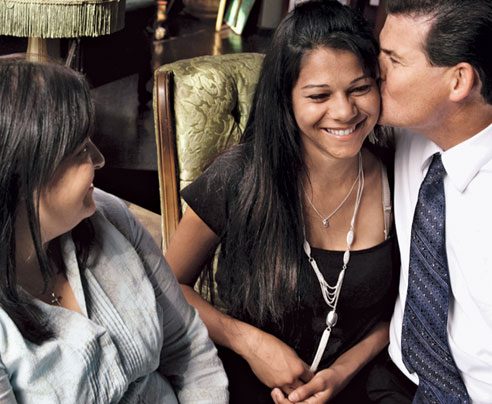
Shyima celebrates with Jenny and Chuck Hall, now her adoptive parents, after testfying at the sentencing hearing for the couple who enslaved her.
Six months later, on the morning of April 9, 2002, Orange County Child Protective Services social worker Carole Chen responded to an anonymous caller (believed to be a neighbor) reporting a case of child abuse. The person said that a young girl was living in the family’s garage, acting as a maid, and not attending school.
Chen, along with Irvine police investigator Tracy Jacobson, knocked at Ibrahim’s front door. When he answered, Jacobson asked who else lived in the house. Ibrahim said his wife and five children.
“Are there other children?” the officer pressed. Ibrahim admitted there was a 12-year-old girl. He claimed she was a distant relative.
“Can I talk to her?” Jacobson asked.
Cleaning upstairs, Shyima was oblivious that her salvation was moments away. Ibrahim called to her in Arabic, telling her to come downstairs and deny that she worked for them. Shabbily dressed in a brown T-shirt and baggy pants, she hurried to the door.
Chen, who noticed that the girl’s hands looked red and raw, called a translator on her cell phone. Shyima told him that she’d been in the country for two years and had never been to school.
Officer Jacobson promptly took the girl into protective custody. Riding in the backseat of the police car, headed to a children’s group home where she would be temporarily placed, Shyima prayed she’d never have to face her captors again. “She was amazing, a very strong child,” Jacobson recalls. “She never cried. Shyima liked being in protective custody, unlike other kids, because she felt safe.”
A few hours later, Jacobson, armed with a search warrant, returned to Ibrahim’s house with agents from the FBI and Immigration and Customs Enforcement (ICE). In the garage, they photographed Shyima’s stained mattress. A bucket of soapy water stood next to a broken lamp; folded clothes were on the floor. “Shyima lived in complete contrast to the rest of the family,” says Jacobson. ICE agent Bob Schoch adds, “I’ve seen pets that are treated better.”
Hoping to justify the arrangement, Ibrahim showed the agents the handwritten, notarized contract he and Shyima’s mother and father had signed. “It said she was to work for them for ten years,” Jacobson says, “for a stipend paid to her parents of $30 a month.”
The investigator arrested Ibrahim and Motelib, charging them with conspiracy, involuntary servitude, obtaining the labor of another person unlawfully, and harboring an alien.
On the day of Shyima’s rescue, immigration officials offered her a choice: Return to Egypt or stay in America and live in a foster home. Nervous and tentative, Shyima phoned her father in Egypt and blurted out, “I want to stay here.” He was angry, but Shyima’s mind was made up: She wanted to start a new, better life.
During the next two years, she lived with two foster families. In the first home, she learned to speak and read English. In the next one, in San Jose, they expected her to become a strict Muslim, and after an argument, they dropped Shyima off at a local group home. “I just wanted to be a regular American teenager,” she says.
She soon got her wish. Chuck and Jenny Hall, parents of two daughters and a son, had recently bought a four-bedroom house in Orange County and decided they had room for more children. After becoming foster parents to a 15-year-old girl and Chuck’s 13-year-old nephew, they were ready to welcome another. At their first meeting with Shyima, “we all clicked,” says Chuck, a uniform company service manager. “She had the same sense of humor I do.”
Shyima had just two questions for her prospective parents: Were there house rules, and what chores would she have to do? “Everything is negotiable,” Chuck answered.
“The No. 1 rule: Homework and school first,” added Jenny, a youth counselor. “We’ll treat you as our own daughter. You’ll be part of our family.”
By then 15, Shyima had blossomed into a beautiful young woman. But she brought more with her than her suitcase. “I had a whole lot of anger,” she says. For the first six months, she had trouble sleeping and suffered from anxiety. She regularly saw a therapist and took medication for depression.
With time, she grew more self-confident. At school, she made friends, including a first boyfriend, and joined the track team. She got a part-time job at a Godiva chocolate store and participated in church dinners and car wash fundraisers. She even volunteered to be a counselor at a camp for children with low self-esteem.
Ibrahim and Motelib, meanwhile, accepted a plea bargain to avoid trial. At their October 2006 sentencing hearing, Shyima sat nervously in the courtroom, listening to their pleas for mercy. “What happened was due to my ignorance of the law, but still I have all responsibility,” Ibrahim told the judge.
Motelib was less repentant. “I treated her the same way as I would treat her in Egypt. I would have been very happy if she had come and told me, ‘Please don’t do this.’ Then I would have changed my actions.”
Unable to contain her outrage, Shyima asked to address the court. “[Motelib] is a grown woman, so she knows right from wrong,” she said. “Where was their loving when it came to me? Wasn’t I a human being too? I felt like I was nothing when I was with them. What they did to me is going to scar me for the rest of my life.”
Ibrahim received a reduced sentence of three years in prison, and Motelib got 22 months. The couple were also ordered to pay Shyima $76,137 for the work she did. Both will be deported to Egypt when they get out of jail.
After the hearing, Shyima celebrated by going shopping for a dress to wear to her high school homecoming dance. She and Jenny chose a beautiful one—long, shiny, and black. With a portion of her restitution money, Shyima also got a laptop, a digital camera, and a new Nissan Versa; she put the rest into a college fund.
“She’s strong-willed and independent,” says Jenny, who with her husband legally adopted Shyima last year. “She knows what she wants.”
As for the future, Shyima says she’d like to be a police officer so she can help other people. She also wants to return to Egypt one day to visit her brothers and sisters. For now, though, she’s content, indulging the dream she never imagined would come true: life as a regular American teen.
Law and Order
The United States started a program in 2000 to crack down on human trafficking and began ranking countries according to their willingness to eradicate the practice. In the most recent ranking, Egypt ended up just above the lowest tier. With urging from the United Nations, more than 100 countries have, in the past five years, passed or amended laws making human trafficking a crime. The State Department has also stepped up efforts to identify, investigate, and prosecute the crime domestically. One hundred and eleven people were charged with human trafficking in the U.S. in 2006; 98 were convicted. Shyima Hall’s case was the first one prosecuted in Orange County.
While on assignment in Sudan, reporter E. Benjamin Skinner met a man who had lived most of his life as a slave. The encounter inspired the new book A Crime So Monstrous: Face-to-Face with Modern-Day Slavery (Free Press), based on Skinner’s five-continent investigation of the human-trafficking trade.
RD: Why do you think slavery still exists?
Skinner: There are pockets around the world where people are absolutely desperate. Criminals will look at an individual with no education, financial resources, or access to credit, and say, “Here’s an opportunity to make money.” Until recently, there’s been little recognition by some countries that slavery still exists within their borders. That attitude contributes to the problem here.
RD: How so?
Skinner: There’s this idea that a domestic worker who’s quiet is probably lacking [immigration] papers, or that somebody on the street dressed a certain way is a prostitute.
A domestic worker who never leaves the house may, in fact, be a trafficked woman, and a prostitute may be a sex slave.
RD: How common is slavery in the U.S.?
Skinner: The low-end State Department estimate of people trafficked into the country annually is 14,500, and there are more than 43,000 slaves at any given time. Overall, about 2 percent get rescued, and the U.S. is one of the best in the world on this.
RD: What can the average citizen do?
Skinner: Victims get out of these situations when individuals say, “Something is wrong here.” So be aware of your neighborhood. Make sure elected officials put modern-day abolition on the American foreign policy agenda. Get involved with groups like Free the Slaves.
RD: What surprised you most about the victims you interviewed?
Skinner: The capacity of human beings to have their humanity ripped away, then rebuild their lives.

