


How to Safely Put Out a Grease Fire

Updated: Apr. 12, 2024





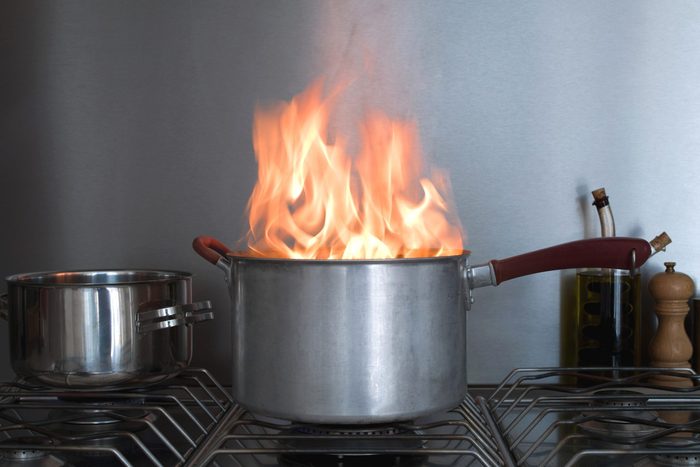
Knowing how to put out a grease fire can prevent your house from burning down and even save your life. Follow these simple steps from a fire safety expert.
A famous proverb proclaims that “a watched pot never boils,” but failing to pay attention to what is cooking in the kitchen—especially on the stove top or in the oven—can end in a catastrophe. Grease fires are more common than you may think. And that’s why it’s absolutely crucial you know how to put out a grease fire.
According to the National Fire Protection Association (NFPA), cooking was the leading cause of reported home fires and home fire injuries from 2015–2019 and the second-leading cause of home fire deaths. In fact, cooking was responsible for a whopping 49 percent of reported home fires, 20 percent of reported home fire deaths, and 42 percent of home fire injuries. The primary cause of these fires? The NFPA points to unattended cooking, particularly frying.
Even scarier is that more than half of civilians injured in home fires involving cooking were injured while trying to put the fire out themselves. Knowing how to put out a grease fire can not only save your house from going up in flames but possibly save your life too. We asked a fire safety expert to explain the proper steps to putting out a grease fire. Once you’ve committed the process to memory, read up on how the best oven cleaners can help you clean your oven, plus the best way to clean stainless steel appliances.
At what temperature does grease catch fire?
We said it before, and we’ll say it again: Don’t leave your food unattended while cooking. Doing so is a fire hazard and one of the two primary causes of grease fires, according to Van Riviere, a former fire department battalion chief and the current CEO of Tablet Command, mobile software that helps firefighters respond to incidents.
The other main cause? The introduction of food or water into hot oil, which can cause the oil to overflow onto an active heating element. In other words, if the oil splashes onto your open flame, you could have a fire on your hands.
And here’s a terrifying fact: If it gets hot enough, cooking oil can catch fire without you doing a thing. How hot is dangerously hot? Riviere cites 2010 research conducted by the University of Maryland Department of Fire Protection Engineering. In the paper (which has yet to be published), the authors identify temperature ranges at which cooking oil will autoignite, using experimental procedures designed to test the autoignition temperatures of liquid cooking oils, butter, and margarine.
They found that the temps at which cooking oil catches fire depend on the type of oil or fat (like butter) that you’re cooking. The chart below, which lists the autoignition points for various fats, is good guidance.
| Vegetable oil | 763 °F |
| Canola oil | 795 °F |
| Olive oil | 815 °F |
| Smart Balance | 810 °F |
| Butter | Doesn’t autoignite |
Need more motivation to keep an eye on your stove top? According to a 2018 study published in the Journal of Fire Sciences, it can take as little as 18 minutes for hot cooking oil to autoignite. That’s reason enough to learn how to put out a grease fire. And while you’re filling your brain with important kitchen tips like these, be sure you know exactly how to use a self-cleaning oven—before you attempt to clean it.
How to put out a grease fire
Snuffing out a grease fire boils down to a few simple but safe and effective steps, explains Riviere. Ready, set, stop that fire!
- Turn off the burner.
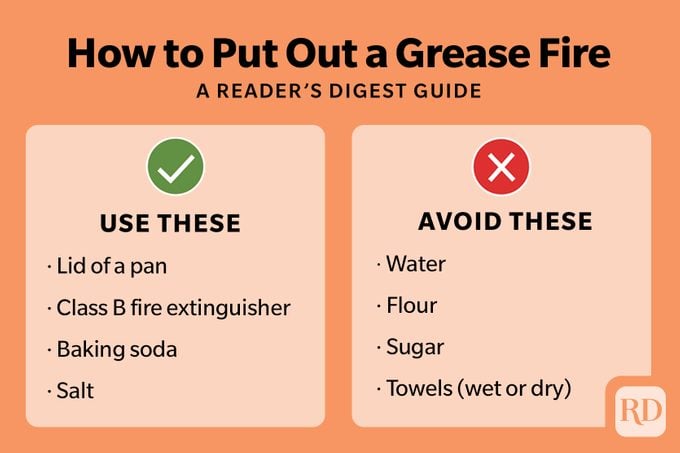
- Keep the pan in place. If you have a fire, your first instinct might be to move the pan. But Riviere says that’s a huge mistake. “Do not attempt to move the pan,” he says. “This will spread the fire throughout the room and likely result in injury.” A lid, however, will rob the fire of the oxygen it needs to grow. This is also why it’s smart to keep your microwave door shut if there’s a fire inside.
- Place a lid over the pan. It’s such an important step, says Riviere, that you should always keep a lid next to the pan while you’re cooking.
- Let the lid smother the fire. Do not remove the lid until the pan is cool. “The fire may rekindle or grow very rapidly,” he says.
- If the fire does not go out, get everyone out of the house and call 911 from outside.
There are a few other ways to put out a fire if you don’t have a lid for your pan. Try these tricks:
- Fire extinguisher: Riviere suggests using a Class B fire extinguisher to put out the fire if you don’t have a lid to the pan. It’ll make a mess and contaminate your kitchen, but it’ll stop the burn.
- Baking soda or salt: Yes, pouring baking soda or salt on a small grease fire will snuff it out, says David Hall, Director of University Safety at Missouri State University and former fire chief in Springfield, Missouri. Just double-check that you’re using the right items. Similar-looking ingredients—including flour and baking powder—can actually make the fire worse. And know that this isn’t a solution for larger grease fires.
How not to put out a grease fire
The last thing you want is to turn a small pan fire into an all-out house fire, so avoid using the items below. Instead of helping, they could make the fire worse.
- Water: Your gut reaction may be to toss a whole lot of water on the flames, but that’s not the solution for grease fires. Pour water on the fire, and the oil could splash and the fire spread.
- Flour and sugar: “Both are combustible and will cause the fire to grow rapidly,” Riviere says.
- Towels: Both wet and dry towels are big no-nos when it comes to grease fires. “It will not extinguish the fire and has the potential to spread the fire throughout the room,” he says.
How to prevent grease fires
Knowing how to put out a grease fire is great. But prevention is really the first step. Riviere has a few tips to keep a potential fire at bay.
- Don’t listen to the famous pot-watching proverb. One of the biggest mistakes people make in the kitchen is not paying attention to cooking food. “Never leave cooking unattended,” says Riviere.
- Pace yourself when it comes to heating up cooking oils. “Always heat grease or oil gradually to avoid heating to the point of combustion,” he says.
- Do not introduce water or ice to hot oil under any circumstances, as they can ignite a fire.
- Add food carefully to avoid spilling grease or oil onto an open flame or hot burner, Riviere says.
- Clean your stove top. If yours is covered in spilled oil, your small fire can quickly get out of hand.
All set on how to put out a grease fire? Great! Now turn your attention to another appliance that can cause house fires: your clothes dryer. Be sure to clean your dryer regularly to lower your risk for fires.
Sources:
- National Fire Protection Association: “Public Education: Cooking”
- Van Riviere, former fire department battalion chief and current CEO of Tablet Command
- University of Maryland Department of Fire Protection Engineering: “Auto-Ignition of Cooking Oils”
- Journal of Fire Sciences: “Characterization of Stovetop Cooking Oil Fires”
- David Hall, Director of University Safety at Missouri State University and former fire chief in Springfield, Missouri

Originally Published: December 07, 2021

