11 Hidden Airplane Features You Had No Idea Existed

Sunny Fitzgerald

By Sunny Fitzgerald

Updated on Aug. 19, 2025

Even if you're a frequent flier, some of these airplane features may be a mystery to you

Hidden airplane features

I’ve been traveling for more than 20 years, and I’m still surprised by some of the things I see on board my flights. And I’m not just talking about bad behavior and other things that get people banned from planes. It turns out there are dozens of interesting and little-known airplane features. Some are hidden away, while others are right under your nose (or, rather, your armrest).

From weird stuff on the wings to symbols that make you go huh, we have answers for you—and a few tidbits that might win you points at trivia night. Ahead, Gina Morello, an aviation consultant, and Patrick Smith, a pilot and founder of the Ask the Pilot blog, explain the purpose behind some of these curious airplane designs. Keep reading to learn more about hidden airplane features that you never knew existed, until now.

Get Reader’s Digest’s Read Up newsletter for more travel, humor, cleaning, tech and fun facts all week long.

1 / 11
Overhead luggage storage on empty airplane
Jodi Jacobson/Getty Images

Hidden handrails

Something that will never be a flight highlight: other passengers aggressively grabbing your headrest (and sometimes your hair!) as they pass through the aisle. But if you’ve ever tried to return to your seat when there’s sudden turbulence, you realize you have no choice but to grip the headrests on the way (minus the hair, hopefully). Or do you?

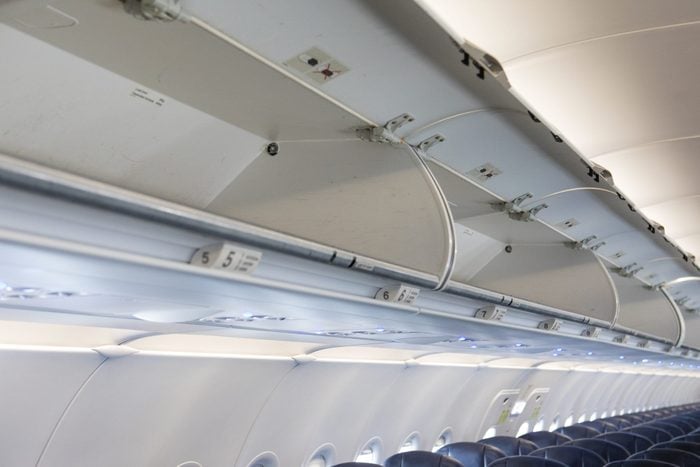
Take a look under the overhead bin. If you see a rail on the bottom, “it’s exactly what it looks like,” Smith says. “Cabin crew use [the handrails] to help themselves maneuver up and down the aisles, and passengers can do the same, especially if you’re up and suddenly it gets bumpy.”

Morello notes that although the handrails are not standard on every aircraft, they have been in use since the early 2000s and are common on newer planes.

2 / 11
secret sleeping room in a commercial aircraft
ivandan/Getty Images

Secret sleeping quarters

I don’t know about you, but long-haul flights leave me feeling like I’ve been run over by a bus. So I definitely would not be fit to carry out flight attendant duties or fly a plane. Luckily for the hardworking people in those positions, there are usually designated rest areas on board.

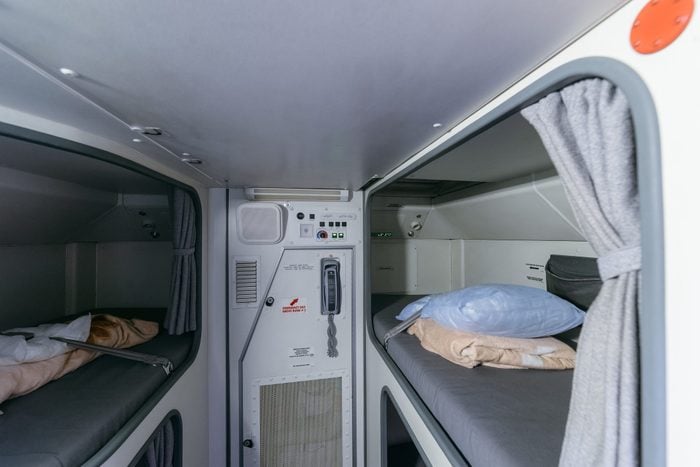
“Most newer, wide-body aircraft have sleeping quarters for the crew called crew rest compartments,” Morello explains. On long-haul flights, cabin crew and pilots must take mandatory rest breaks for safety, and these sleeping quarters support those requirements.

“Designed to be hidden from passengers, they are accessed by a discrete locked door,” Morello says, adding that the size and location vary by aircraft and configuration. “There are usually no windows, and the compartments are comprised of bunk beds, temperature, light and communication controls and a changing area.”

On older aircraft that lack these airplane features, the pilot might sleep in a not-so-secret place. “Sometimes it’s just a cordoned-off seat in business class,” Smith says. But don’t panic! They haven’t abandoned their post. “Transoceanic flights carry augmented crews that work in shifts,” Smith explains. “There’s always a minimum of two pilots in the cockpit, but one or more additional pilots might be on what we call ‘crew rest.'”

3 / 11
Empty airplane seats in second class on an international flight during August peak season
Octavian Lazar/Getty Images

Hidden armrest buttons

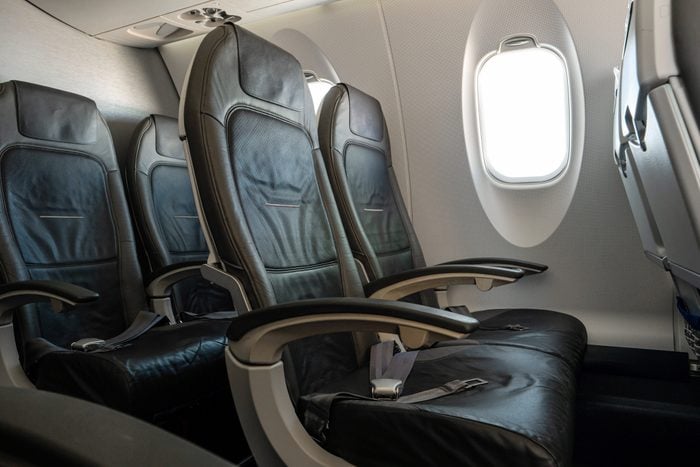
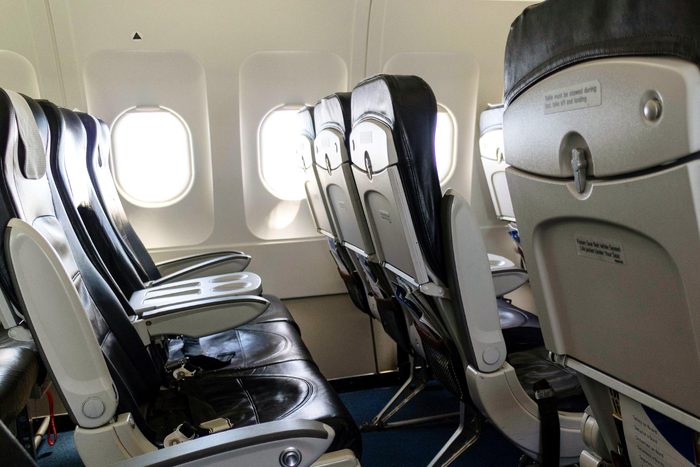
Prefer an aisle seat? Me too. Give me the freedom to move about the cabin without tripping over sleeping seatmates or being trapped by their tray tables! But did you know some aisle seats offer additional flexibility? “There’s a hidden button, near the hinge underneath the armrest of some aisle economy seats, that allows the passenger to lift the armrest,” Morello says.

She notes that the button is primarily there for accessibility, making it easier to enter or exit those tight economy rows (especially helpful if the person in front of you reclines their seat). Don’t leave it up, though: “The aisle armrest must generally remain down during takeoff and landing,” Morello explains. “Also, if the aisle armrest is up, the passenger is more likely to stick out into the aisle and get hit by a cart, a flight attendant or another passenger walking in the aisle.” Having been jolted awake innumerable times by all of the above—even with the armrest down—I agree that you should do what you can to avoid the same.

But! If you find yourself in an empty row with that hidden button and movable armrest on the middle seat, you might score a chance to snooze horizontally. “Moveable armrests in middle seats can allow passengers to lie down on the row of seats for better rest,” Morello says. Not as good as a first-class upgrade, but a nice bonus on those budget travels.

4 / 11
Airplane window breather hole bleed hole with wing blue sky
FrozenShutter/Getty Images

Holes in the windows

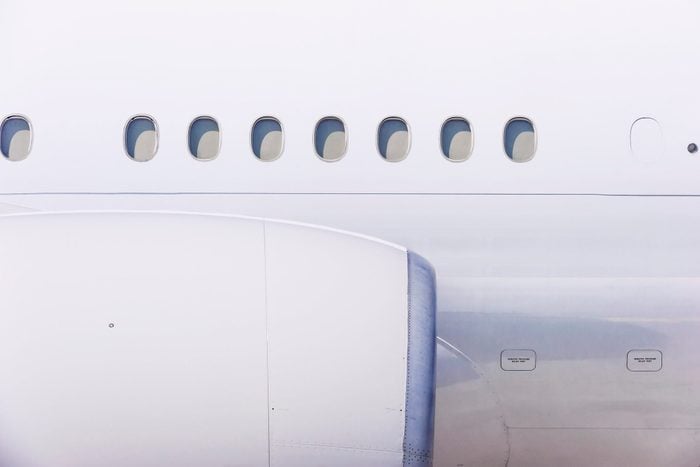
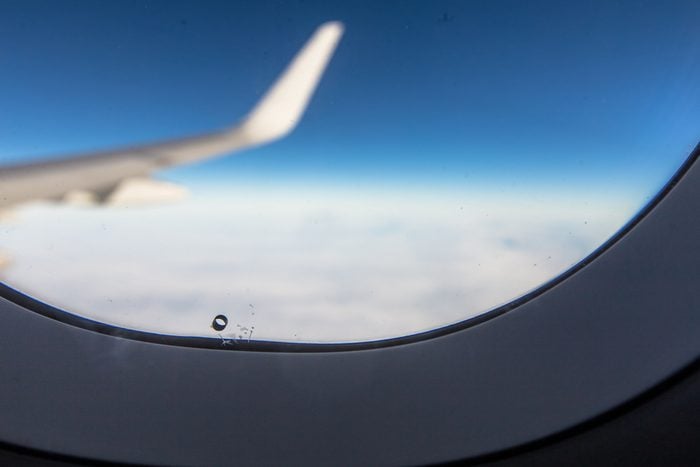
A hole in an airplane window seems like a bad idea, right? Well, yes, an unintended hole could pose a problem. But the tiny hole that you see at the bottom of the window was put there on purpose, and it has an important job.

Airplane windows have three panes, and the hole “occurs in the middle layer, to equalize the pressure between the strong outer window and the interior window pane,” Morello explains. “This is necessary due to the pressure differential between the cabin interior and exterior.”

As a plane ascends and descends, the cabin is designed to stay at a comfortable pressure even as the outside pressure changes. So there’s a big difference in pressure inside and outside the plane. The outside window takes on most of that pressure, so the hole in the middle pane helps balance it out. And the inner window pane? “It’s simply a protective, cosmetic pane,” Smith says. “If it’s scratched or damaged, it’s usually of no concern.”

Cabins are usually pressurized to 6,000 to 8,000 feet (depending on the aircraft) for your safety and comfort, Morello adds, so while you’re flying high, that tiny hole allows small amounts of the pressurized cabin air to move between the panes and equalize.

5 / 11
Airplane wing Flying Over Clouds
Jade Hobbs/Getty Images

Hooks on the wings

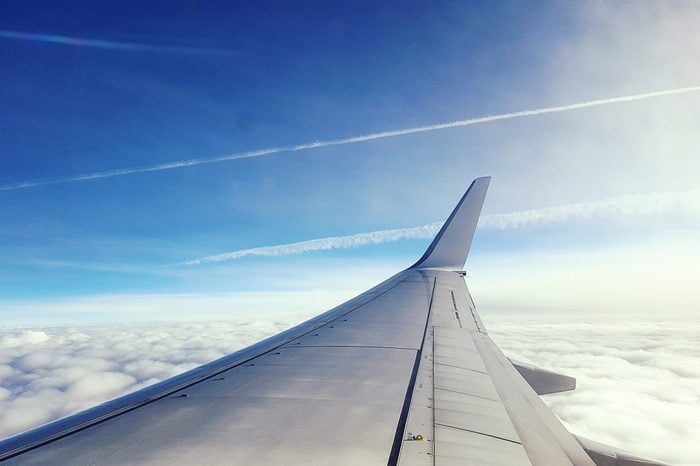
Ever noticed yellow hooks on the otherwise smooth, white surface of some aircraft’s wings? “Those hooks are used to attach ropes, called lifelines, to assist passengers with wing exits in the event of a ‘ditching,’ which is an emergency water landing,” Morello says. Remember US Airways Flight 1549 that landed on the Hudson River in 2009? Now referred to as the “Miracle on the Hudson,” it’s the most famous and successful ditching event, according to Morello.

During a water landing, the emergency inflatable slides should automatically deploy. But to reach the slides, which are designed to be used as rafts, passengers may need to evacuate over the wing, which will likely be slippery. So cabin crew can attach lifelines to the hooks for safer passage.

Morello says that even if the event is not a water exit (like a recent American Airlines overwing evacuation at Denver Airport, due to an engine fire), the wing may still be slippery. In these types of emergency events, the ropes “give passengers stability and help them stay safely on the wings.”

6 / 11
row of seats on an airplane with a black triangle above the window
Education Images/Getty Images

Triangles above the windows

Have you seen those little black triangles above some windows of the plane? “Those are used by the crew to rapidly identify where the wing is located,” Morello says. And their placement has a purposeful design, because they help the crew identify and inspect the leading or trailing edges of the wing to look for problems. “They are deliberately placed such that the marks only line up correctly to the specific part of the wing when viewed from a specific angle,” Morello says.

7 / 11
close up of handcuffs in a black pocket
Evgen_Prozhyrko/Getty Images

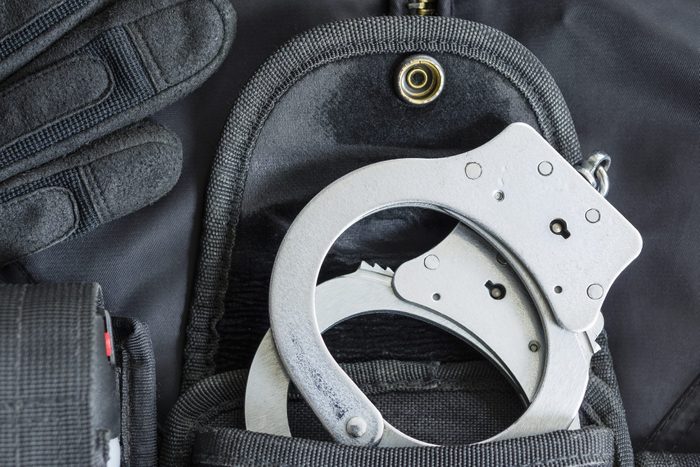
Hidden handcuffs

Every day we hear new stories of passengers behaving badly, from harassing flight attendants and shouting drunken threats to physically assaulting seatmates and wielding skateboards (yep, that really happened). The FAA reported more than 2,100 unruly passenger incidents in 2024, and just under 1,000 in the first half of 2025. Morello says that after a spike in unruly passenger incidents back in 2021, the FAA implemented a zero-tolerance policy—and the first step happens on board.

Yep, that’s when the handcuffs may come out of their hiding place. “The preferred method to deal with a problem passenger is through de-escalation,” Morello says. But if that doesn’t work, the crew might reach for a restraint kit. “Restraining options vary by airline and are used only as a last resort. They can range from duct tape to plastic zip ties to handcuffs.”

When the plane touches down, the restrained passenger is typically handed over to law enforcement, and Morello says they may face fines or prosecution. According to the FAA website, passengers no longer get warnings or counseling. Instead, they will pursue legal enforcement action against any passenger who “assaults, threatens, intimidates or interferes with airline crew members.”

8 / 11
airplane bathroom with sink in the corner and ashtray on the wall
pedrojperez/Getty Images

Ashtrays

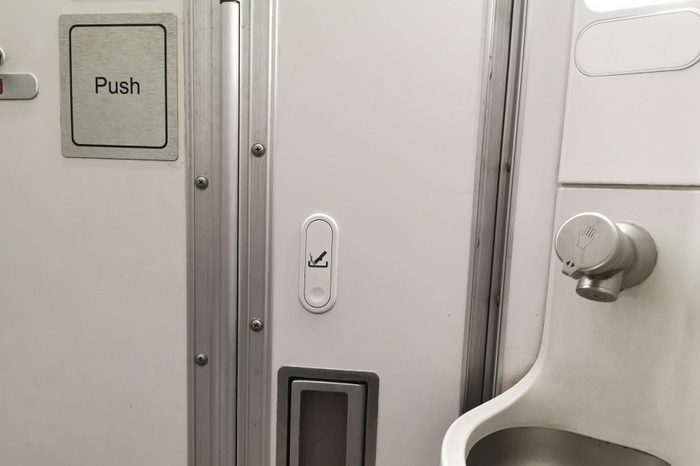
These aren’t hidden airplane features, since they’re right there in plain sight. But given that smoking has been prohibited on airplanes for more than 30 years, there’s still plenty of mystery surrounding them. Why bother with ashtrays when no one can smoke?

“Ashtrays are found in lavatories, even on newer aircraft, for safety reasons mandated by the FAA,” Morello says. “On the off chance a rogue passenger smokes in the cabin, they will have a place to put out the cigarette safely rather than disposing of it in the bin and possibly starting a fire.”

If you thought smoking just fell out of favor, think again. “The final straw for smoking onboard aircraft likely came as a result of the tragedy that occurred in 1998 on Olympic Airways Flight 417,” Morello says. “A passenger died from an allergic reaction to secondhand smoke, despite being seated in the non-smoking section.” In litigation, the airline was found liable for the passenger’s death, and a full smoking ban soon followed.

9 / 11

bathroom sign on an airplane
Konev Timur/Getty Images

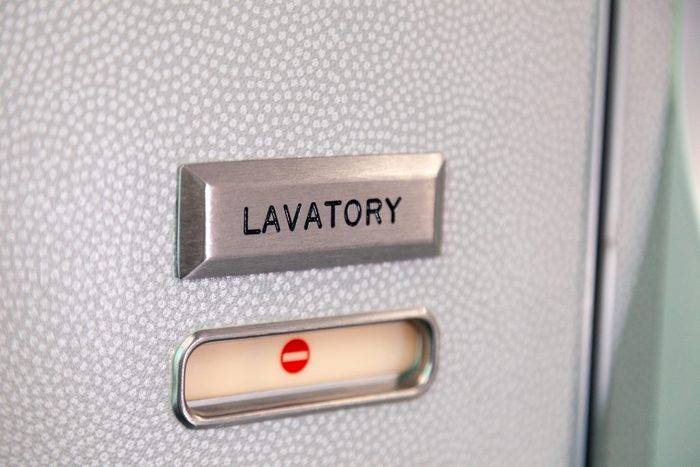
Hidden lavatory locks

Even though you lock the lavatory door from the inside, there is another latch that’s accessible from the outside. Wait, what? “The external lock on the bathroom allows for cabin crew to open the lavatory door in case of an emergency,” Morello says. But the exterior lock doesn’t just allow cabin crew in  it also keeps passengers out when necessary.

“Cabin crew can use the exterior locks to prevent access to the bathroom doors for safety during take off and landing, and also to restrict access if the lavatory becomes inoperable for some reason,” Morello says. Smith notes that lavatories may also be locked during crew shift changes, so pilots going to or from their rest breaks can have access without waiting in line.

If it’s you with the emergency, Morello says to look for the lavatory call button. This button, typically with the image of a person on it, can be found near the sink or somewhere in the lower half of the lavatory within reach of a passenger seated on the toilet.

10 / 11

Medical Carry-on luggage in overhead storage compartment on commercial airplane
CHENG FENG CHIANG/GETTY IMAGES

Life-saving medical equipment

Although it’s not mandated for all aircraft, Morello says automated external defibrillators (AEDs) are required on certain-size planes in the U.S., and many airlines around the world also carry them to help in a medical emergency. They are usually tucked away in the galley or an overhead bin, but sometimes they’re kept in a locked medical kit.

11 / 11

Steel flight deck door on aircraft
BARRY WINIKER/GETTY IMAGES

Fortified door

A successful flight requires a safe cockpit. So one of the most important airplane features is the cockpit door—and not just any old door will do! Morello says that following the hijacking of commercial planes on Sept. 11, 2001, reinforced cockpit doors became mandatory for certain types of aircraft.

The requirement is based on the number of seats, weight and usage, for example scheduled flights versus charter. You probably won’t notice anything remarkable about the door when you briefly pass by it during boarding, but rest assured, on many planes, it is made of sturdy, bulletproof materials to protect from intrusion.

Additional reporting by Marissa Laliberte.

About the experts

  • Gina Morello is an aviation consultant with 25 years of experience and the founder of the travel blog Adventurous Gina. She has traveled to every country in the world and has extensive personal experience with a variety of aircraft.

  • Patrick Smith is an airline pilot and the author of Cockpit Confidential: Everything You Need to Know About Air Travel. He’s also the founder of Ask the Pilot, an aviation blog where he answers readers’ questions about flights, airports, airplanes and more.

Why trust us

Reader’s Digest has published hundreds of travel stories that help readers explore the world safely, easily and affordably. We regularly cover topics such as the best places to visit (and the best times to visit them), tips and tricks to zoom through airport security, flight-attendant secrets, hotel-room hacks and more. We’re committed to producing high-quality content by writers with expertise and experience in their field in consultation with relevant, qualified experts. We rely on reputable primary sources, including government and professional organizations and academic institutions as well as our writers’ personal experiences where appropriate. We verify all facts and data, back them with credible sourcing and revisit them over time to ensure they remain accurate and up to date. Read more about our team, our contributors and our editorial policies.

Sources:

  • Gina Morello, aviation consultant, frequent traveler and the founder of the Adventurous Gina travel blog; email interview, August 11, 2025
  • Patrick Smith, pilot, author and the founder of the Ask the Pilot blog; email interview, August 10, 2025
  • Federal Aviation Administration: “Zero Tolerance for Unruly and Dangerous Behavior Toolkit”
  • CNN: “Passengers evacuate onto wing of American Airlines plane after engine catches fire at Denver airport”
  • ABC7: “Flight headed to LA diverts after unruly passenger breaks free of restraints twice”