


13 Bizarre Christmas Laws You Never Knew Actually Existed

Updated: Feb. 12, 2023





Holy Christmas, Batman, these laws relating to what you can and can't do on Christmas actually exist!
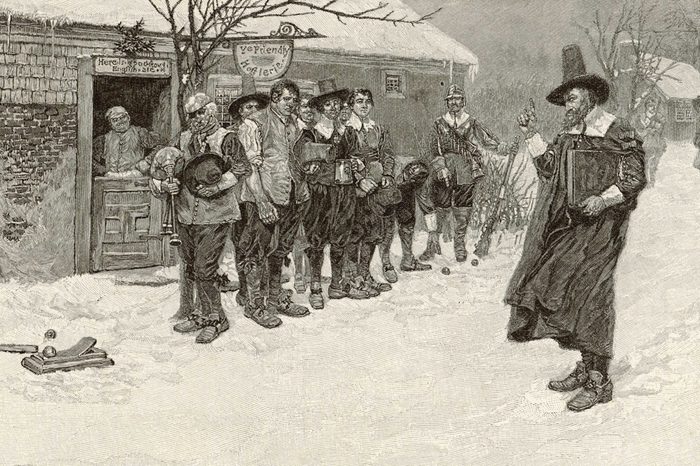
The “War on Christmas” is actually a thing
Christmas celebrates the birth of Christ, which one might think would make it a hands-down joyous occasion. Nope. Christmas has actually been a source of controversy in the United States since the earliest Colonial days. In fact, in 1659, the Puritan government of the Massachusetts Bay Colony went so far as to outlaw Christmas in order to discourage “disorderly” behavior that might be “offensive to God.” Anyone who failed to show up for work or participated in feasting would be fined five shillings. The Christmas ban lasted until 1681 and Massachusetts didn’t make Christmas an official holiday until 1856. Find out the best Christmas town in every state where the holiday spirit is alive and well today.

The English were the first to ban Christmas
Massachusetts wasn’t the first place to ban Christmas. Back in 1643, England passed an ordinance “encouraging” citizens to treat Christmas as a solemn holiday, rather than a celebratory feast. By the next year, Christmas had been banned altogether. Christmas remained illegal in England until 1660 (one year after Massachusetts banned Christmas). Find out the origins of 10 beloved Christmas traditions.

No paying of debts
In sharp contrast to the New England law against recognizing Christmas, Arkansas passed a law in 1838 making debt that would otherwise be payable on Christmas, payable one day earlier, aka Christmas Eve. In other words, if a debt you owed was to come due on Christmas, you’d have one less day to pay it. Likewise, if a debt owed to you was payable on Christmas, your debtor would be required to pay it one day early, thus depriving you of one days’ worth of interest. Official score in Arkansas: Debtor=0, Creditor=0. Here are 15 Christmas Eve traditions to start this year—and none of them involve paying off debt.

A grace period for paying a debt
Unlike Arkansas, Louisana adopted a law in 1837 that made Christmas Day a grace period with regard to bill paying. In other words, if a debtor had a debt come due on Christmas Day, they would have until December 26, also known as Boxing Day, to pay it. Accordingly, debtors would have one more day with their money, interest-free, while creditors would lose a day of interest. Official score in Louisiana: Debtor=1, Creditor=0.

The Christmas Bonus Law
“Aguinaldo” refers to an annual Christmas bonus that businesses in Mexico are required by law to pay to their employees, according to Investopedia. Payment must be made by December 20, and companies that fail to do so lay themselves open to significant fines (as much as 315 times the legal daily minimum wage). Costa Rica has a similar law.

The war on Christmas trees?
In New York City, there is a law prohibiting the display of natural (non-artificial) Christmas trees in retail stores. In Philadelphia, there is a law prohibiting natural trees in high-rise buildings and any other dwellings that are designed to house more than two families. In both cases, the reason is it’s considered a fire hazard.

Christmas tree tax
Since 2011, a 15¢ tax has been assessed on the sale of every Christmas tree in the United States. The purpose of the tax is to fund a marketing program to improve the image of Christmas trees (similar to “Got Milk?” and “The Incredible Edible Egg” campaigns). Don’t believe it? Snopes confirms it, although they say it’s not truly accurate to call it a “tax,” and it’s only levied on wholesalers. Nevertheless, it’s likely that wholesalers pass the levy onto retail customers. Find out 12 secrets your Christmas tree wishes you knew.
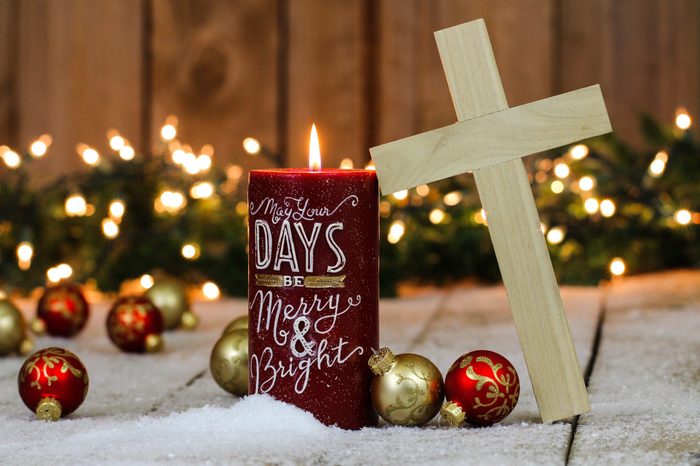
Yes to the tree, no to the cross
In 2016 in Knightstown, Indiana, it became illegal to have a cross on top of a Christmas tree in a public display. “The cross is not a Christmas symbol,” said a representative of the American Civil Liberties Union. “The cross is the pre-eminent symbol of Christianity and it reminds Christians not of the secular trappings of Christmas, but of the crucifixion and the resurrection of Jesus.”

Don’t lose that receipt
In Michigan, if you like having a freshly cut Christmas tree, be prepared to retain the receipt. That’s because it’s illegal there for anyone to transport a Christmas tree without having proof of the sale of the same.

The ban on candy canes
In Nebraska in 2018, an elementary school principal banned candy canes in the school because “historically, the shape [of the candy cane] is a ‘J’ for Jesus. The red is for the blood of Christ, and the white is a symbol of his resurrection.” Also banned: anything suggestive of the religious holiday of Christmas (including reindeer, Elf on the Shelf, and anything red and green).

No booze in the eggnog in Arkansas
In Arkansas, the sale of alcoholic beverages is prohibited on Christmas Day. Period. End of story. That’s not to say one can’t drink alcohol in the privacy of one’s own home on Christmas, but if you want to do so, you’ll have to make sure you’re stocked before Christmas arrives. Find out 13 more of the strangest liquor laws in the United States.
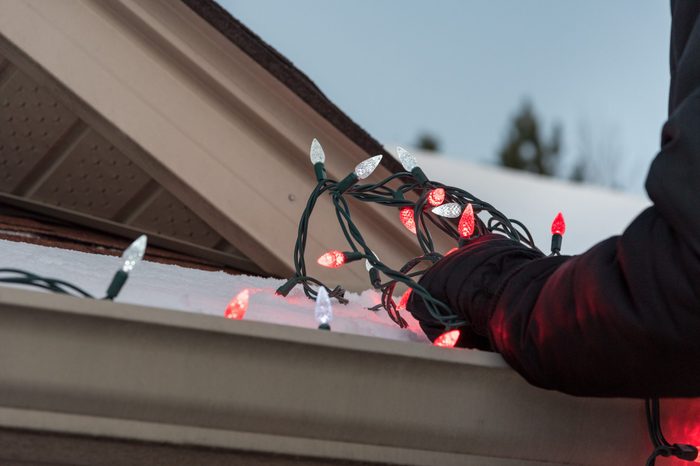
Laws against being lax about taking down your Christmas lights
Many states and municipalities in the United States have laws regulating how long you’re allowed to keep your Christmas lights up after Christmas. In San Diego, you have until February 2. Scofflaws face cash fines of $250. In Maine, fines may be levied any time after January 15.
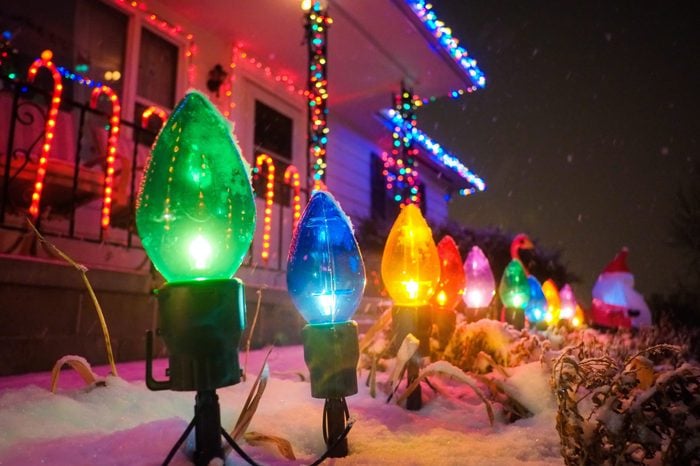
Laws against “light trespass”
Your Christmas lights can be guilty of “trespass” under “light trespass” laws, which prohibit such things as “misdirected” or “excessive” artificial light caused by “inappropriate” or “misaligned” lights that produce “unnecessary” glowing. New Jersey, in particular, is known for its light trespass laws. You may be better off with a visit to one of the 20 best small towns for Christmas lights.
Originally Published: December 02, 2019

