


If a Cop Taps Your Taillight When You’re Pulled Over, This Is What It Means

Updated: Apr. 24, 2024






Hint: They're not trying to buff out that scratch above your bumper
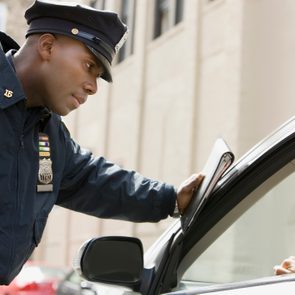
If you have a habit of binge-watching police procedurals or if you’ve ever received a traffic violation, you may be familiar with this scenario: Through a blare of sirens, a car is pulled over by law enforcement. Both vehicles are parked on the side of the road. After a tense few moments, a police officer steps out of the car and calmly walks toward the driver. As they approach the rear of the vehicle, the officer taps the left-hand taillight with their hand. If you’ve ever seen this happen, you’ve likely wondered, Why do cops touch the taillight of a car?
During a traffic stop, there are many procedures that must be followed not only for the safety of the violator but also for the safety of the officer. While tapping the taillight may be a lesser-known routine step (compared to asking for your license and registration, for example), it was standard procedure across the police force at one time. This practice isn’t rooted in superstition, and it isn’t a policing secret. As it turns out, it’s based in the officer’s well-being.
We spoke to a retired police-academy instructor and a defense attorney to find out the reason behind this behavior—and whether you should be concerned if it happens to you.
Get Reader’s Digest’s Read Up newsletter for more trivia, humor, travel, tech and fun facts all week long.
About the experts
|
Why do cops touch the taillight of a car?
According to Nick Fresolone, a retired police-academy instructor with the New Jersey State Police Academy in Sea Girt, New Jersey, the “taillight tap” leaves fingerprint evidence on the glass of the taillight to prove that the officer was present at the scene. Ultimately, says Fresolone, if things escalate or otherwise go awry, the officer’s touch to the car’s taillight will have left a fingerprint in a place where investigators would know to look for it.
Criminal defense attorney Joe Hoelscher says that this routine maneuver serves as a sort of breadcrumb left to prove that the police officer had approached that particular vehicle. “Leaving a thumbprint on the brake light is an old-school way to tag a car with a fingerprint, so it can be identified conclusively as the vehicle involved in a stop should the officer become incapacitated,” explains Hoelscher.
Law-enforcement officers pull over more than 50,000 drivers on a typical day and more than 20 million motorists every year, according to the Stanford Open Policing Project, which means following protocol is vital for public and officer safety.
While taillight taps aren’t as ubiquitous today (more on that below), they can still be a simple and worthwhile procedure for law enforcement. For example, a police interaction that begins with a speeding ticket for someone with a spotless record may have the potential to escalate into something more serious. Proving that a certain police officer was, in fact, at the scene is important. “Never be complacent,” Fresolone still tells rookie officers, by which he means no matter who is at the wheel and how spotless their record, “you must not skip any of the protocols.”
Is the taillight tap still necessary?
Given the proliferation of CCTV on street corners, dash cams on cars and surveillance cameras worn by law enforcement, why do cops touch the taillight of a car? While this quaint procedure to leave fingerprints on a car is still very common, it is no longer taught to every police officer, says Fresolone.
Because there are other ways to establish a police officer’s presence at a scene (i.e., technology), some police departments do not treat the taillight tap as a requisite step in traffic-stop procedure. “I’ve talked to some younger officers who seem confused over whether they should be touching a car’s taillight at a traffic stop,” Fresolone says. “They’re still seeing it being done by their older colleagues, but they’re wondering why the taillight tap was not presented to them as traffic-stop protocol.”
Nevertheless, Fresolone believes that getting your fingerprint on the taillight is something every officer should still do for their safety and the safety of the public at large. “It’s a simple thing to do, but it could be the only evidence of a police officer’s presence in the event of a technological glitch,” Fresolone says.
“It is less important now that video is ubiquitous,” Hoelscher adds, “but it requires so little effort that some officers are still trained to do it.”
What other reasons might an officer tap a taillight?
While leaving evidence that an officer was present at the scene is Fresolone’s main reason for tapping the taillight of a vehicle during a traffic stop, some other reasons have been cited. According to the Law Dictionary, some officers may tap the taillight to ensure the trunk is latched and no one could pop out.
No matter the reason, keep in mind that those fingerprints could have a negative effect on future law-enforcement interactions, says Hoelscher. When a car’s taillights are dusty, the officer’s fingerprint can stand out, he says. If this is the case for your car, “the next officer might be more aggressive realizing you’ve had another law-enforcement interaction recently. So my advice is to wash your car after getting a ticket or the next time you get stopped.”
Why trust us
At Reader’s Digest, we’re committed to producing high-quality content by writers with expertise and experience in their field in consultation with relevant, qualified experts. We ensure that all information is accurate and offers the best possible advice to readers. We verify all facts and data, back them with credible sourcing and revisit them over time to ensure they remain accurate and up to date. Read more about our team, our contributors and our editorial policies.
Sources:
- Nick Fresolone, retired police academy instructor with the New Jersey State Police Academy; interview, 2023
- The Stanford Open Policing Project: “Findings”
- Joe Hoelscher, trial lawyer based in San Antonio, Texas; interview, August 2019
- The Law Dictionary: “Why Do Policemen Touch Your Tail Light When They Pull You Over?”

Originally Published: August 15, 2019

