


How Do Cruise Ships Float?

Updated: Jul. 08, 2024





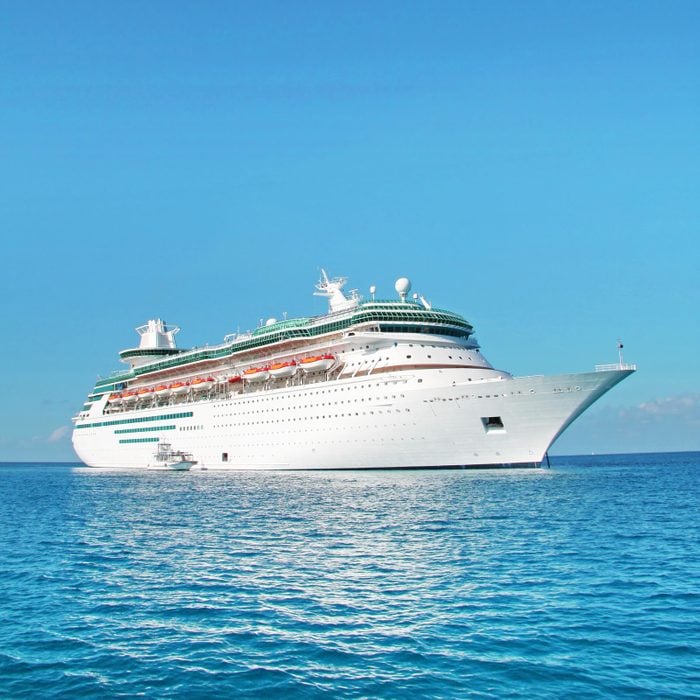
Considering cruise ships are practically big enough to block the sun, we had to ask: How do cruise ships float?
If you’re lucky enough to have taken cruises over the past several decades, you’ve probably noticed a trend: Everything has gotten a whole lot bigger. That’s especially true of cruise ships. In 1912, the Titanic was the hugest ship ever built; in 2022, Royal Caribbean International launched the Wonder of the Seas, the world’s largest cruise ship. It might seem as unbelievable as the answer to how high airplanes fly, but the Wonder of the Seas clocks in at a whopping 236,857 gross tons—that’s five times the size of the Titanic. With 18 decks, four pools, several waterslides and eight “neighborhoods” (to help the nearly 7,000 people on board navigate), you might wonder: How do cruise ships float?
You’d have good reason to puzzle over the science. Every ship on the best cruise lines weighs more than 100,000 gross tons, after all. (For context, consider that the Titanic weighed around 58,000 tons.) That’s a lot more room for pools, lodging, entertainment and even hidden cruise ship features.
For the crew, making such a huge vessel sail efficiently doesn’t just require a knowledge of cruise ship code words or an understanding of the things guests can’t do on cruises anymore. It also requires something most of us left behind in high school: a basic understanding of elementary physics.
But you don’t have to own a lab coat to understand how a ship the size of an apartment building doesn’t sink to the bottom of the sea. Our super-simple explainer will teach you the basics, so get comfortable and get ready to learn a little science. In fact, go ahead and sink into a relaxing bubble bath as you learn about the science behind buoyancy.
Get Reader’s Digest’s Read Up newsletter for more knowledge, humor, cleaning, travel, tech and fun facts all week long.
How do cruise ships float?
In the simplest terms, ships float because their weight is less than the weight of the water they displace.
If you’ve ever carried a bucket of water, you know that water is incredibly dense—that’s why it feels so heavy. Cruise ships may be huge, but the ocean is much, much bigger. The U-shaped hull of a cruise ship displaces thousands of tons of water, pushing it down and to the sides, but the ship doesn’t sink because the density of the water pushes back against the ship, keeping it afloat.
Let’s break it down further: Whether you’re on a singles cruise or a family-friendly voyage, your ship is likely heavy with engines, decks, rooms, buffets, people and hot tubs. But it’s also full of air, which is much less dense than water. In other words, the total density of the ship is less than the density of the ocean waves.
It’s the same reason you can float in the ocean but sink in the bath. See, we told you a bubble bath would help! It’s not just a place to ponder interesting facts or questions like, “Have cruises recovered from the pandemic?” According to mathematics legend, the principle of buoyancy was actually worked out in a bathtub.
What is Archimedes’ principle?
You may have heard the story: A smart guy in ancient Greece is struggling with a math problem, takes a bath, figures out the answer and leaps out of the bath, yelling “Eureka!” That’s ancient Greek for “I’ve found it,” not “I forgot my robe!” (Coincidentally, that’s also what we yelled when we found a great deal on a Disney cruise.)
What that ancient Greek guy—Archimedes—figured out was that as he sank into the water, the water rose, becoming displaced. Therefore, if he could measure the displaced water, he would have an accurate measure of the volume of his body. This became known as Archimedes’ principle.
He used the principle to figure out if a goldsmith was cutting his gold with a less-dense metal, such as silver (as the story goes). But you can use it to understand buoyancy.
In order for your body or even a giant cruise ship to float, the downward force of the object on the water needs to be less than the upward force of the water pushing back against the object. According to NASA, Archimedes’ principle states that the buoyant force (the differences between the upward and downward forces) on an object in water is equal to the weight of the water the object displaces.
Think about a toy boat: It floats because the volume of water it displaces is tiny compared to the volume of water in the bath. Now imagine that boat is a cruise ship, and the bath is the ocean. That’s why you can watch an ice-skating show on an adults-only cruise in the middle of the Caribbean or scale a rock-climbing wall as your ship sails around Europe. Thanks, Archimedes!
What else helps cruise ships float?
Motion and materials also go a long way toward helping cruise ships float. As the ship moves forward, it pushes water away from itself (displacement again!). Like a pendulum, the water returns to fill up the displaced space, and that force pushing upward also helps to keep the ship afloat.
The choice of materials is also incredibly important. These days, all ships—from family cruises to all-inclusive cruises—are made of extra-strength steel. For starters, this provides better protection against icebergs. (The Titanic sank because an iceberg ripped a hole in its side, causing it to take on water, which increased its density and, well, you know the rest.) Plus, extra-strength steel is denser than water, so it can withstand the enormous pressure of the ocean.
Cruise ships also usually include a double hull—a hull within a hull. This is an additional layer of protection and definitely why you’re much more likely to read about themed cruises than cruise disasters these days.
In short, if you’re wondering “how do cruise ships float?” you’ll find buoyancy, materials and motion together in the answer.
Why don’t cruise ships tip over?
OK, so we’ve covered buoyancy and learned how cruise ships float, but there are still a few mysteries to solve. (Like, what are those white balls on cruise ships? Or why do some cruise ships have wings on them?) Cruise ships may have as little as 30 feet of the ship below the water, with more than 200 feet sitting above it. It’s windy out there on the open ocean! Forget the “how do cruise ships float?” question. How come they don’t tip over?
Again, it comes down to science and design. If you’ve played Jenga, you know that the second your tower gets top-heavy, it’s only a matter of time until it’s tumbling down. That’s because a low center of gravity is your best insurance. Cruise ships keep their heaviest equipment—fuel tanks, engines, machinery and freshwater tanks—in the lowest part of the ship for just that reason. The upper parts of the ship tend to be much more open, which also allows wind to pass through.
Cruise ship stability is also dependent on the shape of the hull. Fast boats tend to have a V-shaped hull to cut through the waves, while cruise ships have a U-shaped hull. The rounded bottom of the ship may cause it to move through the water more slowly, but it also limits rocking and motion. This is a good thing, as anyone prone to seasickness will tell you.
By now, you should be able to answer “how do cruise ships float?” like a modern Archimedes. That means it’s time to book your next sea-going adventure! Check out our comprehensive guide on what to pack for a cruise, and you’ll be the most prepared passenger on deck.
Sources:
- Royal Caribbean Blog: “Comparing Titanic vs. biggest cruise ship in the world”
- What Things Weigh: “Weight of Cruise Ship”
- Let’s Talk Science: “Why do ships float?”
- Scientific American: “Fact or Fiction? Archimedes Coined the Term ‘Eureka!’ in the Bath”
- NASA: “Buoyancy: Archimedes Principle”
- How Stuff Works: “How Cruise Ships Work”


Originally Published: April 28, 2023

