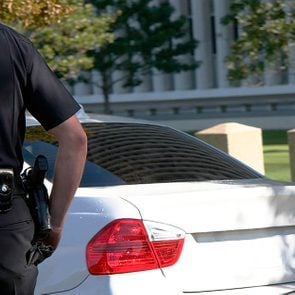
Whenever I visit Scandinavia, I’m always impressed by how effortlessly drivers coexist with everyone else on the road. Even though the cities are packed with transit, cars, bikes and pedestrians, it seems like looking out for one another is very much second nature. And I’ve come to realize that at least part of the reason for this harmony comes down to how you open your car door.

Wait, there’s a right way to open your car door? There sure is. As it turns out, another northern European country perfected a clever door-opening technique called the Dutch Reach method, and it’s spreading across the world—including to the United States. It’s so simple that it can (and should) become a habit everywhere for drivers and their passengers. Keep reading to find out how to open a car door, and how this small change is actually a really big deal.

Get Reader’s Digest’s Read Up newsletter for more knowledge, cleaning, travel, tech and fun facts all week long.

What’s the right way to open your car door?

It’s called the Dutch Reach method, and it’s brilliantly simple.

To execute, simply open your car door with your inside hand: Instead of grabbing the door handle with the hand nearest the door, reach for the door by crossing over your body with the hand farthest from the door. (In the U.S., that’s the right hand for drivers and the left hand for passengers.) This move causes anyone opening the door to have to swivel their upper body and head, meaning they’ll have a better view of any bikers coming up from behind.

Why should you open a car door with your inside hand?

It helps prevent a potentially deadly mistake known as “dooring,” in which bicyclists are struck by a car door that’s flung into their path. After making the Dutch Reach, drivers continue with care, slowly opening the door just a little at a time while looking for cyclists. The whole process eliminates the dangerous door-flinging that causes dooring accidents and biker injuries.

The point hit home the last time I visited Copenhagen. Just as I was about to hop out of my friend’s car, she stopped me and reminded me to check for bikes first. I did and carefully opened the door without hitting anyone, which definitely would have happened if I hadn’t looked first. (Then I carelessly stepped straight into a stream of oncoming Danish cyclists and was nearly flattened.) I pretty quickly learned that in a city where biking rules the road, you better learn the rules too.

How big of a problem is this?

Dooring can be deadly for people on bikes and for those riding scooters and other micro-mobility devices. “It can also cause life-altering or debilitating injuries,” says Alison Dewey, education director at the bike-safety advocacy organization League of American Bicyclists.

Although dooring is a serious issue, Dewey says that there is, unfortunately, no direct national research dedicated to the topic. Still, she points out that the continued use of the Dutch Reach method in the Netherlands “demonstrates its popularity in places where biking is an everyday occurrence for so many residents.” She adds that efforts like the Dutch Reach “show the importance of being cognizant of vulnerable road users at all points of operating a vehicle.”

As biking and protected bike lanes continue to expand across the U.S., some states have taken cues from Dutch safety practices. The Massachusetts DOT, for instance, added the Dutch Reach to its drivers manual in 2017, and Illinois followed the next year. “We would love to see more states including information about the Dutch Reach in driver education programs, tests and campaigns,” Dewey says.

Why is it called the Dutch Reach?

Here's Why You Should Always Open Your Car Door With Your Inside Hand Gettyimages 2209513170
MYSTOCKIMAGES/GETTY IMAGES

The Dutch Reach was originally known simply as the “far-handed door exit,” and the technique reportedly began appearing in Dutch media as early as the 1960s. As biking rose in popularity in the U.S., the method—though not the name—was referenced in a 2011 New York Times opinion piece titled “The Dutch Way: Bicycles and Fresh Bread.” In it, Russell Shorto says Dutch drivers are taught to use the move, and schoolchildren must pass a bike safety exam. “The coexistence of different modes of travel is hard-wired into the culture,” he writes.

The Dutch Reach officially received its catchy name in 2016, when a campaign to popularize the method was launched stateside and went viral, the Boston Globe reported at the time.

Can you still use the Dutch Reach if you’re a leftie?

Yes. The Dutch Reach works for anyone seated in a car. Simply reach across your body with the hand opposite the door, then slowly open the door. Make sure to watch for cyclists that could be coming up behind and beside the car.

Dewey emphasizes that the key is learning that the technique exists, understanding why it’s important and using it. “Then,” she says, “it’s about practice and repetition, like any habit.”

Does it matter if you’re not parked on a road?

Even if you’re just in a driveway or parking lot, it’s still wise to continue opening doors this way to build muscle memory and stay aware of other potential hazards—including pedestrians and people in wheelchairs—not just bikers in traffic. “Motorists should remember that cyclists are people who also deserve to arrive at their destination safely,” Dewey says, and that goes for everyone else on the road too.

About the expert

  • Alison Dewey is the education director at the League of American Bicyclists. She has held multiple positions with the League since joining the organization in 2008. Before that, she worked for Massachusetts-based Landry’s Bicycles, where she spent two years managing a store and two years as marketing coordinator.

Why trust us

At Reader’s Digest, we’re committed to producing high-quality content by writers with expertise and experience in their field in consultation with relevant, qualified experts. We rely on reputable primary sources, including government and professional organizations and academic institutions as well as our writers’ personal experiences where appropriate. We verify all facts and data, back them with credible sourcing and revisit them over time to ensure they remain accurate and up to date. Read more about our team, our contributors and our editorial policies.

Sources: