


Why Do Cats Put Their Butt in Your Face? Experts Explain the Reason for This Awkward Behavior

Updated: Mar. 05, 2024





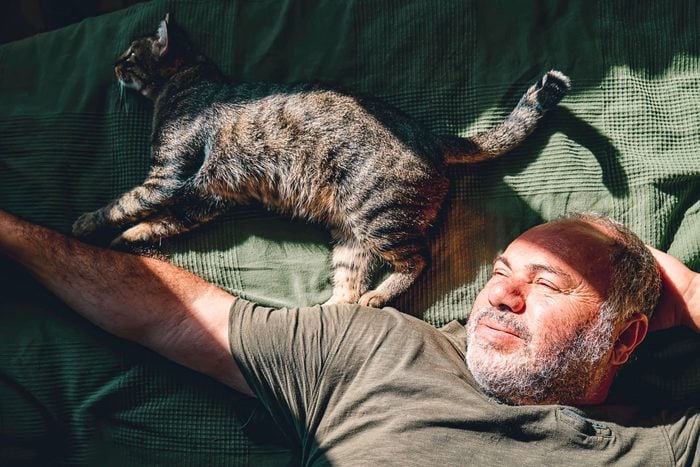
There’s so much to love about your cat: Those sparkly eyes. That little pink nose. Those little tufts of fluff sprouting from his ears. But when you come home after a long day at work and go to nuzzle that cute little cat face, what does he do? He pulls a 180 and puts his butt right in your face. “It’s really kind of comical,” says Jennifer Hawkins, DVM, executive director of the Southern California Veterinary Medical Association. “I think most of us know it’s not intended to be an insult, but it does seem a little rude.”
So why do cats put their butt in your face? As with so many other quirky aspects of cat behavior—like why your cat licks you or rubs up against you—there is a reason cats do what they do. We asked a panel of veterinarians and cat behaviorists why cats seem to be so fond of flashing their rears, what’s behind this strange feline body language and if there’s a way to train your cat to stop doing it. Here’s what you need to know.
Get Reader’s Digest’s Read Up newsletter for more pets, humor, cleaning, travel, tech and fun facts all week long.
About the experts
|
Why do cats put their butt in your face?
There are actually a few reasons for your cat to put his backside in your face—and all of them indicate a strong bond between you and your furry friend. So yes, this behavior is actually a positive thing!
Your cat really likes you
It may seem off-putting, but when a cat puts his butt in your face, it’s actually a sign that he likes you. A lot. “Humans have some people we greet with a handshake, and others we greet with a hug,” says Dr. Hawkins. “This is a cat’s way of greeting you with a hug. It’s a warm greeting, like: ‘Here’s my backside—here’s who I am.’ And they don’t do it with everybody. Cats only do it with their special people.”
Your cat trusts you
When a cat puts his butt in your face, he’s leaving a vulnerable area of his body exposed, says Amy Tate, DVM, co-owner of Riverview Animal Clinic in Birmingham, Alabama. In short, it means your cat trusts you implicitly. “To turn their body in a way that is trusting and friendly is a sign your cat has accepted you into their social group,” she explains. “You should consider it high praise.”
Your cat wants attention
Aside from professing his love and trust, your cat is likely also looking for a little petting or some food. “Cats are smart,” says Dr. Hawkins. “They know we’re not cats, so they don’t expect us to respond like a cat would and put our nose in there, but they are looking for some love and attention in return.” It’s not just the most affectionate cat breeds that exhibit this behavior either.
It’s just what cats do among friends
“Cats that have a friendly relationship will often greet each other with nose-to-nose sniffing and then a round of anal sniffing,” says certified cat behaviorist Pam Johnson-Bennett. “When your cat walks up to you and presents their rear end, it’s a friendly gesture and an invitation. Of course, your cat will understand if you don’t want to follow [suit].”
Is there an evolutionary reason for this behavior?
Butt-sniffing is common behavior in the cat world, because cats use scent as a major form of communication. “Cats engage in sniffing to gather information about each other,” says Johnson-Bennett. Presenting their butts to another cat—or a human—is also a way they show they are not a threat.
Some experts think it may have something to do with the way very young kittens present their backsides to their mothers for cleaning. “When they’re brand-new babies, they don’t defecate on their own,” says Dr. Hawkins. “They have to get their bottom cleaned by their mother, so that is sort of a nurturing behavior that the mother does with the kittens. It could be part of what triggers this behavior, part of an affection that they show to each other.”
What does this behavior mean for your relationship with your cat?
If your cat regularly puts his butt in your face, you should consider it proof that the bond between you and your cat is strong. “It may seem insulting that kitty chooses to put their back end toward you, but it’s actually a compliment,” says Johnson-Bennett. “It means the cat feels comfortable and safe. This is a positive sign indicating a strong bond.” Chances are, it also means your cat is happy in that moment.
What should you do when your cat does this?
“You should be flattered!” says Dr. Hawkins. “When it happens, a lot of us kinda smile, like, Uh, OK. But it’s a warm greeting, and I would respond with a little scratch to the base of their tail or petting them along their spine.” It’s the perfect way to acknowledge the kitty honor and to give them a little affection in the process.
How can you get a cat to stop putting their butt in your face?
Of course even cat lovers might not actually want to be looking at cat butt all day. So how do you get a cat to stop putting his butt in your face? Well, a cat’s going to do what a cat’s going to do, but there are a few things you can do to minimize the behavior.
Head them off at the turn
Essentially you’ll just want to interrupt the positioning before the cat has completely turned his back to you. “When your cat starts to turn around you can just start petting,” says Johnson-Bennett. “It will let kitty know you have received and appreciate the gesture. Don’t push them away because that will create confusion and could damage the bond you share.”
Redirect their attention
Find something else to do together that you both enjoy. “Move to engaging your cat in play or petting/grooming activities,” says Dr. Tate. “Food can be the wrong reward at this time because we mistake the meowing that comes with this behavior as hunger cues when it is really a need for social interaction.”
Ignore it
“If you give them attention, you are encouraging the behavior,” says Dr. Hawkins, “so if it’s something that really annoys you, ignore it. Have you ever hugged somebody that didn’t hug back? It’s sorta awkward. But cats don’t get offended too terribly. They might just choose you a little less often.” Now that you know the real reason cats put their butt in your face, you might not mind it quite as much.
Want to learn more about the weird quirks and funny habits of your pets? Dr. Phur on The Pet Collective is a seasoned doggy doctor serving up inside information plus the best tips and tricks for the care of all your animal friends.
Why trust us
At Reader’s Digest, we’re committed to producing high-quality content by writers with expertise and experience in their field in consultation with relevant, qualified experts. We rely on reputable primary sources, including government and professional organizations and academic institutions as well as our writers’ personal experience where appropriate. We verify all facts and data, back them with credible sourcing, and revisit them over time to ensure they remain accurate and up to date. Read more about our team, our contributors and our editorial policies.
Sources:
- Jennifer Hawkins, DVM, executive director of the Southern California Veterinary Medical Association.
- Pam Johnson-Bennett, certified cat behaviorist and the owner of Cat Behavior Associates, a private veterinarian-referred behavior company in Nashville. She is the author of eight books on cat behavior and training, including Think Like a Cat.
- Amy Tate, DVM, co-owner of Riverview Animal Clinic in Birmingham, Alabama.

Originally Published: August 30, 2023

