


The “Penny Has 5 Children” Riddle: Try to Solve the Viral Riddle

Updated: Mar. 11, 2024





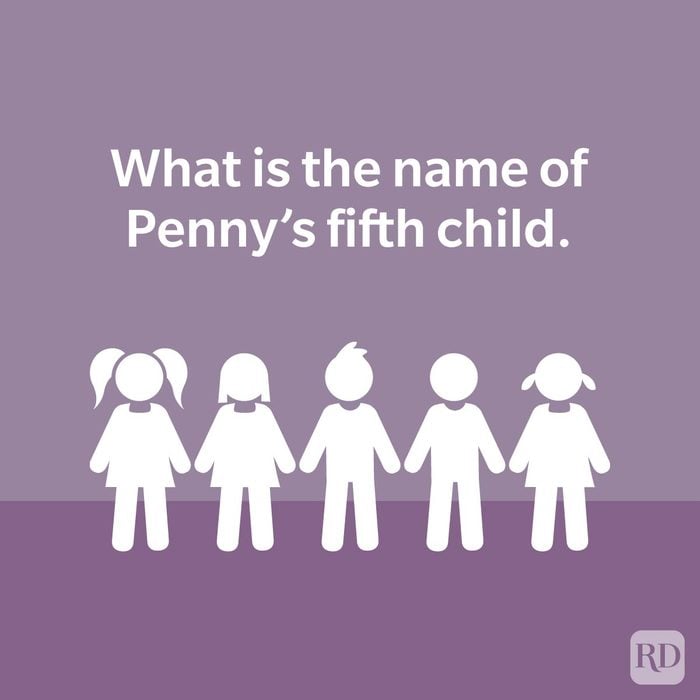
Penny has five children and a penchant for giving her kids some rather unusual names. You know the first four, but can you guess the fifth?
Riddles are meant to confound, but in a way that’s meant to be clever and fun. In other words, if these math riddles were merely confounding, they wouldn’t hit home so much as feel like homework. Same with these hard riddles. Even these easy riddles might seem unduly challenging if it weren’t for a carefully calibrated element of “gotcha.” And that’s why the “Penny has five children” riddle has been gaining traction on the internet.
When you first encounter the Penny has five children riddle, you might think the answer is obvious. At the same time, you’ll wonder how it could be so obvious and still be a riddle. All will be revealed, of course, when you learn the solution. And when you do, you’re going to want to share it with everyone, because their reactions will be, shall we say, priceless.
Get Reader’s Digest’s Read Up newsletter for more riddles, humor, cleaning, travel, tech and fun facts all week long.
The “Penny has five children” riddle
Penny has five children. The name of Penny’s first child is January. The second is called February. Penny’s third child answers to the name March. The fourth one’s name is April. What is the name of Penny’s fifth child.
And that’s all there is to this tricky short riddle!
The hint
At the risk of giving away the solution, the best hint we can offer is that everything you need to solve this riddle can be found within the riddle itself.
The solution
The solution to the “Penny has five children” riddle is “What.”
The explanation
The “Penny has five children” riddle consists of six statements. The first is that Penny has five children. The next five reveal the names of Penny’s five children, one by one. Like many of these classic riddles from history, this one does not pose a question, per se; nevertheless, it courts a response from the riddle-ee. And if you assumed the response to be “May,” that is perfectly understandable.
The reason is that evolution has favored the human brain’s inherent desire to process information by forming patterns. That’s why, when we look up at the night sky, we’re able to see familiar shapes. Indeed, science tells us that our inclination to detect a pattern—even where none may exist—is the very essence of the highly evolved human brain. And that’s exactly what’s happening in the “Penny has five children” riddle.
When your highly evolved human mind registers that the first four of Penny’s children are named after the first four months in the calendar (in order), it’s logical to assume that the fifth child’s name follows the same pattern and is, therefore, “May.” But the riddle states in clear and unequivocal language that “What” is the name of Penny’s fifth child. Sure, it may not be the most popular baby name in your state, but that doesn’t mean it can’t be the name of Penny’s fifth child. In fact, it is.
Other versions
Like the “green glass door” riddle, which has been vexing the internet for months now, the “Penny has five children” riddle comes in more than one flavor. One version is meant to address the absence of a discernible question in the original by ending with the question: “What is the name of Penny’s fifth child?” The trick here is that the question uses “what” as a noun, rather than as an interrogative. Accordingly, the answer is “yes,” although “true” would suffice. Even “what” would be an acceptable response. But never “May.”
Another version is designed to trip up those who are already familiar with the original version. It does so by presenting a similar scenario, albeit one that has been transformed by a subtle yet significant tweak. To wit, this version’s first statement is not that Penny has five children but rather that Penny’s mother has five children. Accordingly, in this version, which ends with the question “What is the fifth one’s name?” the answer is “Penny.”
Now that you’ve cracked the “Penny has five children” riddle, you should feel adequately prepared for both the “someone’s mother” riddle and the “there’s a woman in a boat” riddle.
Sources:
- Frontiers in Neuroscience: “Superior pattern processing is the essence of the evolved human brain”
- Psychology Today: “Are you seeing patterns that don’t exist?”

Originally Published: March 11, 2024

