Here’s Why We Celebrate Groundhog Day in the First Place
Updated: Feb. 25, 2024





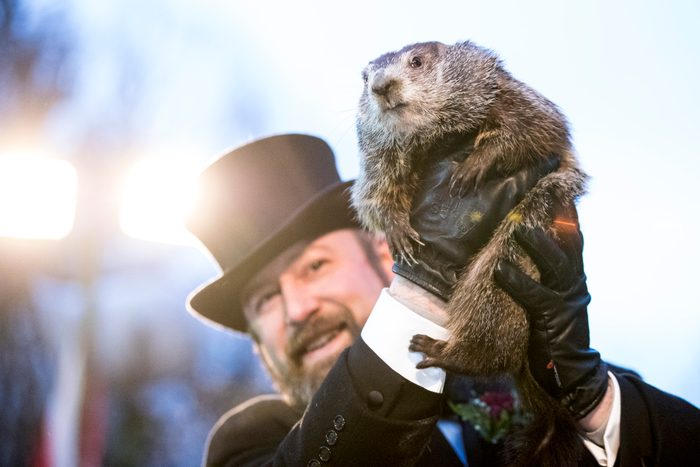
The surprising history of Groundhog Day and Punxsutawney Phil's rise to fame goes back thousands of years
What is Groundhog Day, anyway?
Every year on February 2, crowds gather at Gobbler’s Knob in Punxsutawney, Pennsylvania, to watch a groundhog emerge for the day—just like in the classic Bill Murray film Groundhog Day. You know the drill. If he sees his shadow and promptly runs back to his burrow, bad news: There will be six more weeks of winter. But if he doesn’t see his shadow, spring is right around the corner.
In reality, groundhogs don’t make the best meteorologists, and poor Punxsutawney Phil doesn’t have a great track record. As of 2022, he’d made the right call just 39% of the time, according to Stormfax. So how did the bizarre tradition of Groundhog Day get its start? We did a little investigating and got to the bottom of Groundhog Day’s history and evolution.
What is the history behind Groundhog Day?
The roots of Groundhog Day aren’t as random as they might seem. The beginning of February marks the halfway point between the winter solstice (the shortest day of the year) and the spring equinox (when night and day are about the same length). Pagans would celebrate February 1 or 2 with a festival of light to mark the start of spring. According to Gaelic legend, if the goddess Cailleach wanted a long winter, she’d make the day bright so she’d have sunlight to gather more firewood. But if it was a cloudy or dreary day, she’d stay in because spring was on its way.
Medieval Christians adapted the festival and handed out candles. This feast day, called Candlemas, falls 40 days after Christmas, marking the end of the period when Jewish tradition would have considered Jesus’ mother unclean after giving birth. She would have been allowed to worship in the temple again, so February 2 is also considered the day that baby Jesus would have been presented there for the first time.
One old English song also connects Candlemas to the weather:
“If Candlemas be fair and bright,
Winter has another flight.
If Candlemas brings clouds and rain,
Winter will not come again.”
Eventually, Europeans started looking to animals’ hibernation patterns on Candlemas to predict the weather. Some watched to see if bears would come out of their dens, while the English looked for hedgehogs, and the French waited for marmots.
Germans, whose tradition said a badger would walk out of its hole if there was snow but retreat back inside if the sun was out, brought the custom to the United States. The Pennsylvania Dutch gave it their own twist by replacing badgers with groundhogs, probably because the hibernating animals were so common in the Keystone State.
In 1887, watching for Punxsutawney Phil became an official event. Since then, other cities have started looking to their own groundhogs, like New York’s Staten Island Chuck and Georgia’s General Beauregard Lee. Whichever furry forecaster is your trusted favorite, cross your fingers for a speedy, shadow-free spring. Now that you know Groundhog Day’s history, check out these other famous groundhogs that aren’t Punxsutawney Phil.
Source:
- Stormfax.com: “Groundhog Day”