


We Bet You’ve Never Noticed the Typo on the Lincoln Memorial
Updated: Jul. 20, 2021


You had one job, Lincoln Memorial engraver.
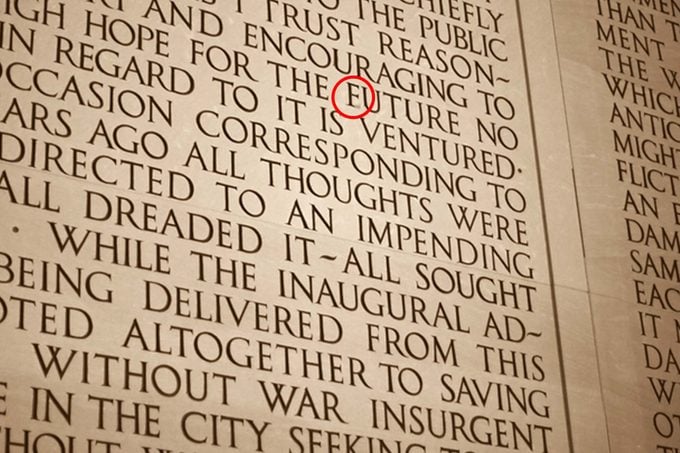
When the Lincoln Memorial was dedicated on May 30, 1922, the world bore witness to how $2,000,000 in federal funds, eight years of American elbow grease, and 38,000 tons of marble, granite and limestone could result in something truly extraordinary: A very, very expensive typo.
Yes, despite its many merits as a national landmark and work of art, the Lincoln Memorial enshrines what may be the greatest blunder in American monument-making. Step into the Memorial’s interior and turn your attention to the north wall. Chiseled into the stone is Lincoln’s Second Inaugural Address, delivered on March 4, 1865, less than two months after the successful passing of the Emancipation Proclamation. In his speech, the war-weary president expressed his “high hope for the future” of his drastically changing and bloodied homeland.
Except, not in the Lincoln Memorial. To hear the engraver tell it, Lincoln was more concerned with his “high hope for the euture.” Visit the Memorial today and you can still see where the bottom of the “E” in “EUTURE” was eventually filled in with slightly off-colored stone to become “FUTURE,” more or less.
Given the time, money, and prestige behind the Lincoln Memorial project, you might think it’s outrageous that such an obvious spelling blunder could make it past so many stakeholders. But the fact is, engraving typos are a shockingly common occurrence, with an even more common explanation: simple, stupid, human error. For further evidence of this, just pop across the Potomac river to Arlington Cemetery. According to a spokeswoman for the cemetery in 2014, at least 4,125 of the field’s roughly 280,000 tombstones were overdue for corrections to the names or dates etched onto their faces. More often than not in these cases, the fault is with the families of the bereaved, who may well miss tiny mistakes when reviewing proofs of the proposed gravestones. At the Lincoln Memorial, chances are an overworked architect signed off on the typo well before the engraver made his mark. Check out these funny typos that were printed in well-known books.
But there’s no use throwing around blame. Anyone who has ever written a report for school or work knows that typos are a force of nature—and maybe we should start embracing them. Take San Francisco. Street names stamped into the cement sidewalks of San Fran are notoriously riddled with misspellings and backwards letters (according to a SFGate report, one woman who lived on Broadway was “flabbergasted” to find the twin misspellings “BRODWAY” and “BROADWEY” stamped onto a single intersection). Local historian Eric Fischer has caught more than 200 of these typos on the streets of ‘Frisco, and you won’t hear him complaining about them. “Errors are really interesting,” he told SFGate. “They’re an indication of process. Perfection doesn’t tell you how it was made. It’s when you see the scratch in a piece of wood that you understand how it was done.”
Perfection doesn’t tell you the true story. This is a sobering point, even in the shadow of great men like Abraham Lincoln. Preserved in majestic marble, it’s easy to forget that Abe himself was as flawed and fragile a human as you, me, or the engraver who botched “future.” Lincoln ate. He slept. He battled depression. And, on more than one occasion, he halted conversation to tell a really long fart joke. Why not inscribe that on his monument, right across from the Gettysburg Address? To see a man at his best and at his worst is to see a man as he truly is—to see the tree itself, and not just the shadow of the tree, as Abe was fond of saying.
No man is a monument unto himself, and no monument need be either. Now isn’t that a view worth preserving for euture generations? Next, learn about some of the most expensive typos in the world.
