


12 Things That Must Happen When a President Dies

Updated: Nov. 08, 2023





From how long flags fly at half mast to the exact speed of the funeral procession, these are the traditions that are followed when a sitting or former U.S. president dies
What happens when a U.S. president dies
After every death there is always a mourning period, but when a president dies, the mourning period looks a little different. Whether the president that passed is currently in office or was a former president, here is everything that must happen when they die.
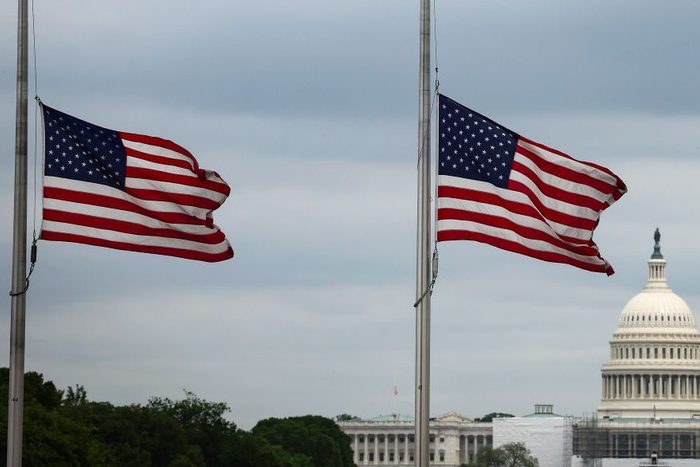
Flags fly at half-staff
Per federal law, all government buildings, public schools, offices and military bases must lower their flags to half-staff for 30 days when a U.S. president or former president dies. The sitting president is also expected to issue an official announcement of the death, as well as authorize the closure of federal buildings, agencies and departments to observe a national day of mourning.
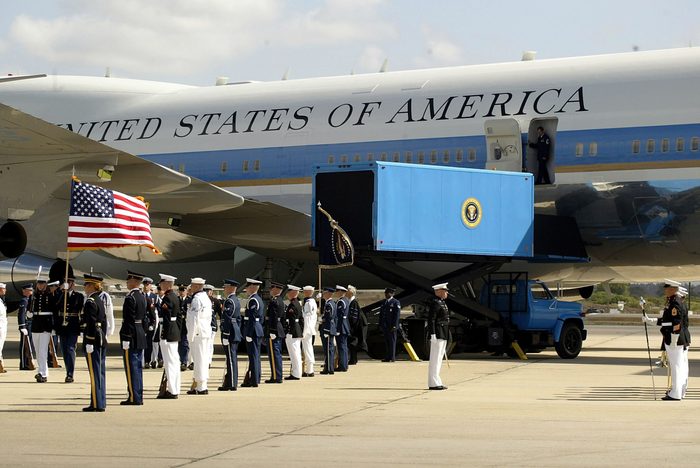
The casket is transported to the Capitol
Most former presidents return to their home states after leaving office, which means the body needs to be transported to the U.S. Capitol. That was the case with Ronald Reagan, who after passing away at his home in Simi Valley, California, in 2004, laid in state at his presidential library for two days before his casket was flown to Washington, D.C. Presidential caskets receive a military escort and are flown on a presidential plane, as Reagan’s was (shown above).
The president’s family plans the funeral
Morbid as it may seem, one of the first tasks a new president must complete is to plan his own funeral service, according to the White House Historical Association. Yet it is the president’s family who ultimately coordinates the funeral. Family members often choose to add symbolic touches to the ceremony; for example, widowed first lady Jacqueline Kennedy modeled John F. Kennedy‘s 1963 funeral after Abraham Lincoln’s. “They can choose to have a simple funeral; they can choose to have a full honor funeral. It simply is up to the family,” Barbara Owens, state funeral planner for JTF-NCR, told the Associated Press.
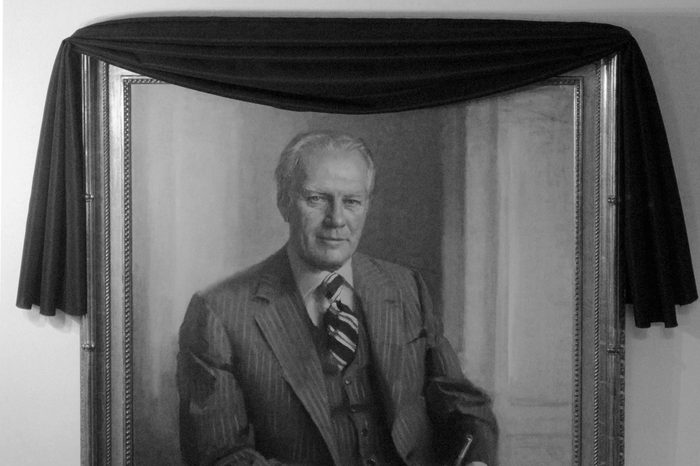
Portraits and buildings are draped in black
As a symbol of mourning and to honor the life and legacy of President Gerald Ford, his official portrait in the White House was draped with black fabric—and white roses were arranged on a table beneath it—when the former president passed away in 2006, according to the White House Historical Association. When President William H. Harrison died in 1841, just 30 days after his inauguration, his funeral planner requested that the entire White House be draped in black, and many official buildings and private residences followed suit.
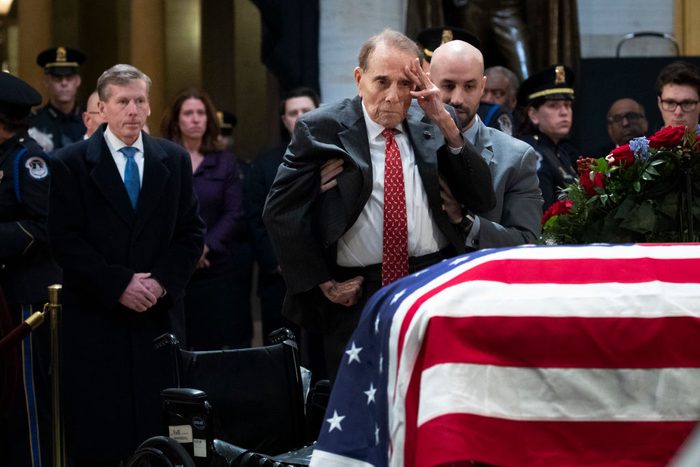
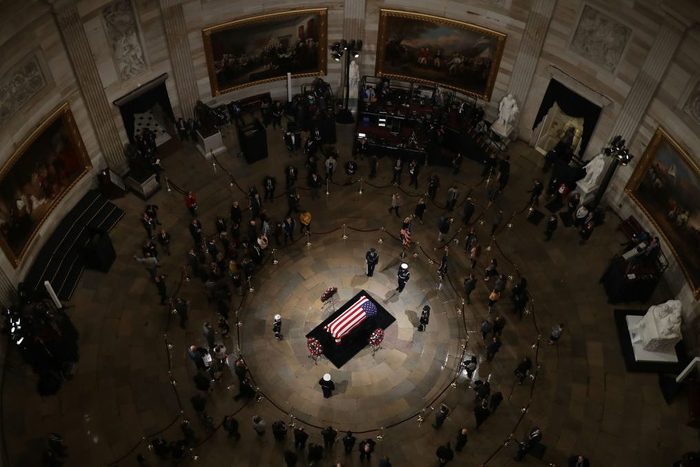
The president’s casket lies in state
It has become customary for a sitting or former president’s casket to lie in state in the Capitol Rotunda for several days, allowing the public, including other elected officials and current and past presidents, to pay their respects. (Above, in 2018, former Senator Bob Dole paid tribute to President George H.W. Bush’s casket as it lay in state at the Rotunda.) Only presidents who have passed away while in office have laid in the White House for viewing. That includes Franklin Roosevelt, William H. Harrison and Zachary Taylor, all of whom laid in state in the White House’s East Room; the latter two were even honored with a funeral ceremony there.
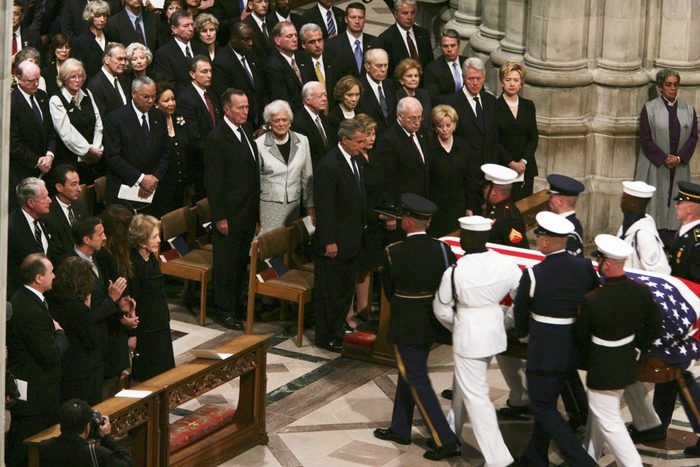
Mourners attend a multiday funeral
Both private and public services are held over the five-day span of events to pay tribute to a deceased president. Though the private service is reserved for grieving family members and friends, the national funeral service includes attendees from around the world. This ceremony is almost always held at the Washington National Cathedral in Washington, D.C. and often shuts down the nation’s capital for days, as Reagan’s did in 2004 (shown above). As for the funeral’s actual arrangements, “the ornateness and symbolism will vary with the president’s popularity and political coalition,” according to Elizabeth Sanders, professor of American politics at Cornell University.
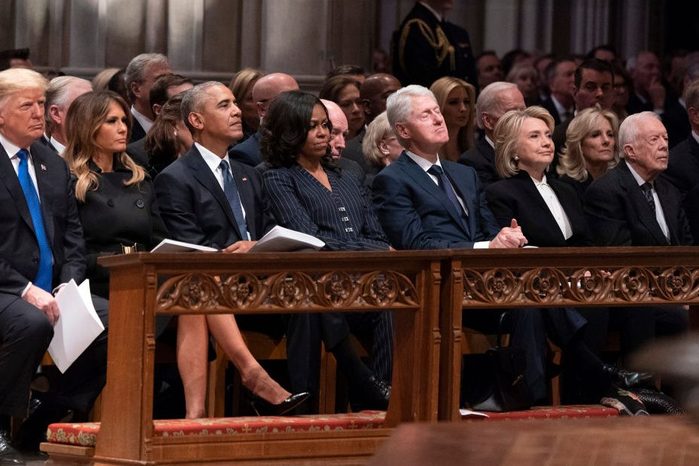
Funeral planners create a seating chart
It’s no secret that presidential funerals are far from simple, easygoing affairs. Instead, each detail is meticulously planned—all the way down to where the funeral attendees must sit. According to the Associated Press, “The presidential party is followed by chiefs of state, arranged alphabetically by the English spelling of their countries. Royalty representing chiefs of state come next, and then heads of governments followed by other officials.” President George H.W. Bush’s funeral in 2018 saw four living presidents come together along with their spouses: President Donald Trump and Melania Trump, President Barrack Obama and Michelle Obama, President Bill Clinton and Hillary Clinton and President Jimmy Carter and Rosalynn Carter (not pictured).
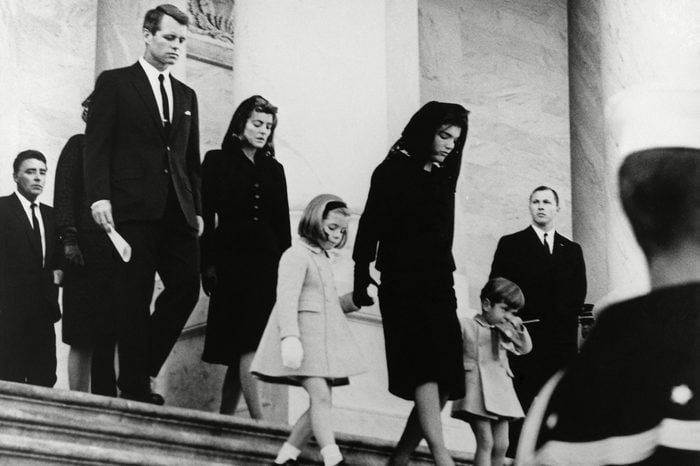
The funeral procession marches through D.C.
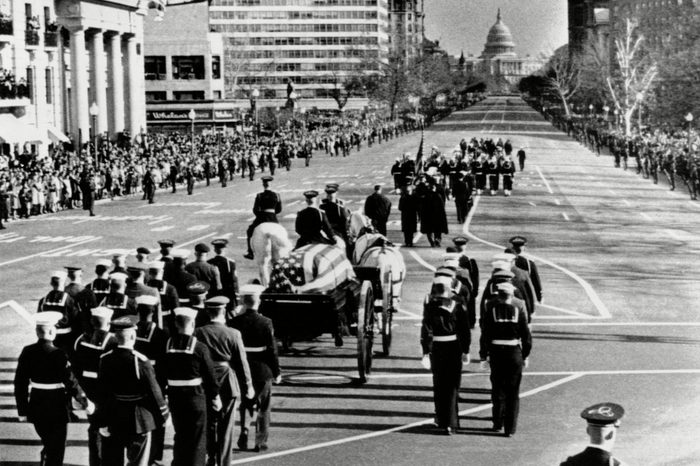
Before a presidential casket heads to its final resting place, it might travel down Pennsylvania Avenue in Washington, D.C., one last time. Some presidents have requested their casket be carried by a traditional horse-drawn carriage, while others have preferred to use a modern motorcade. These processions are by no means the norm, as just eight deceased presidents have had them, including President Kennedy in 1963 (shown above). But there is one thing that all processions have in common: They must move at a speed of exactly 20 miles (about 32 km) per hour in order to make sure the day’s events stay on schedule.
The U.S. military gives a final salute
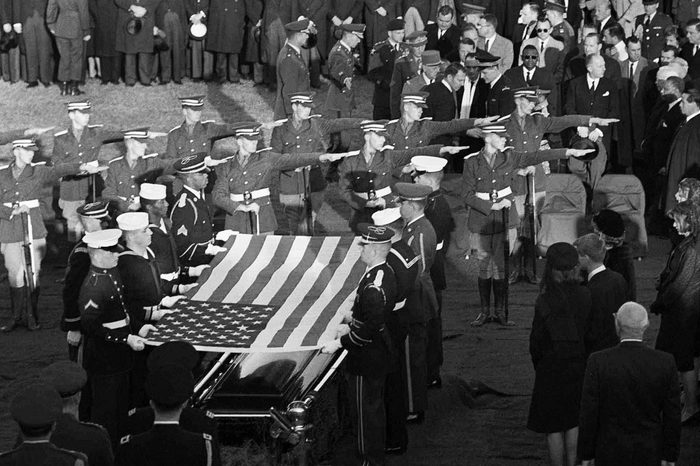
All U.S. presidents, as former commanders-in-chief of the United States Armed Forces, are entitled to receive full military honors at their funerals. Tradition calls for their caskets to be draped with an American flag and carried on the shoulders of a nine-person team from the Armed Forces during the funeral service. On the day of the burial, seven honor guards form a rifle party and fire a three-volley salute over the gravesite, a custom that dates back to the Roman military, and military forts around the country hold 21-gun salutes; starting at noon a gun will be fired once every minute for 21 minutes. Later, at the lowering of the flag, a 50-gun salute of 50 rounds shot at 5-second intervals symbolizes the 50 U.S. states.
The casket crosses the country by train
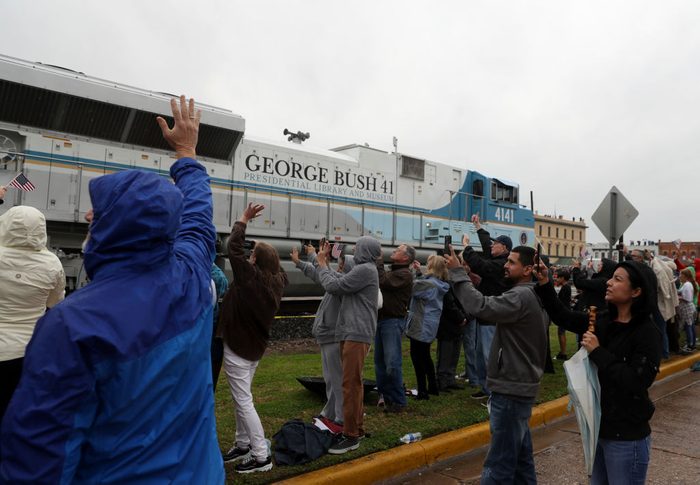
Back before the days of airplanes and highways, a train often carried the body of a deceased president across the country to its final resting place, according to Mike Purdy, presidential historian. “This allowed thousands of Americans to pay their respects as the train passed their cities, towns and farms,” he says. Former presidents Abraham Lincoln, Ulysses S. Grant, William McKinley, Franklin D. Roosevelt and Dwight Eisenhower all had a presidential funeral train procession. When George H.W. Bush passed away in 2018, his family also opted to follow this tradition.
The president is buried at a personal site
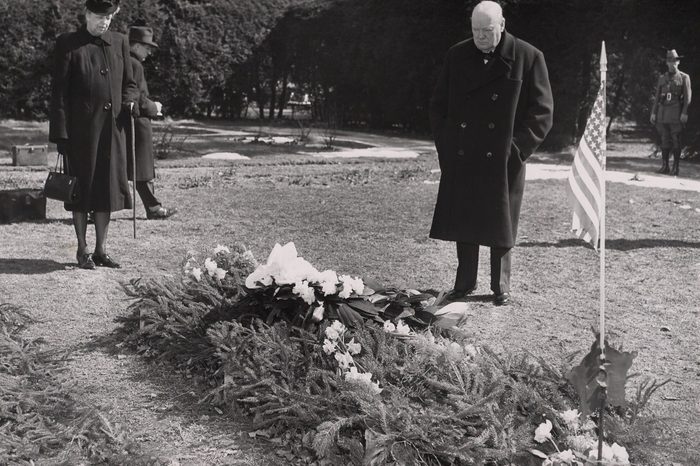
Presidents often choose to be buried in a place that holds personal significance to them or their families, such as a presidential library, hometown residence or even a public monument. Presidents John F. Kennedy and William H. Taft are buried at Arlington National Cemetery, while Presidents Ronald Reagan, George H.W. Bush and Franklin Delano Roosevelt are buried on the grounds of their presidential libraries. (Above, in 1946 British Prime Minister Winston Churchill pays his respects to Roosevelt’s gravesite in Hyde Park, New York, alongside FDR’s widow, Eleanor Roosevelt.)
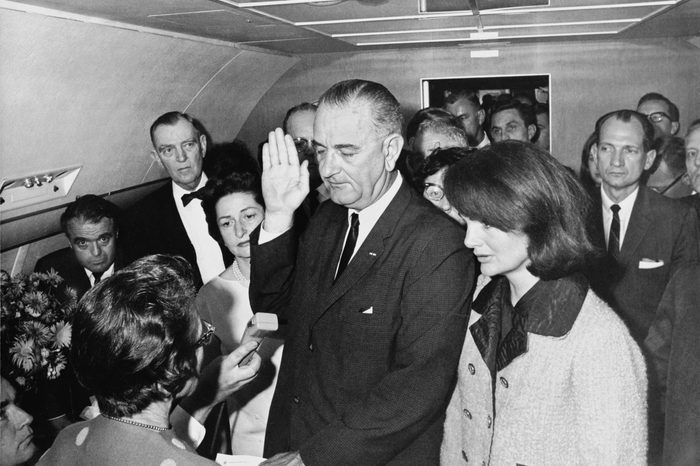
If a president dies while in office, the vice president must take the oath of office
When a sitting president unexpectedly dies, passing presidential power to the vice president is “the most urgent task to be accomplished,” according to Purdy. “While the vice president automatically becomes president upon the death of the president, [taking the oath of office] telegraphs to the nation and world the official recognition that there is a new president,” Purdy says. The last time a president died in office was 1963, when Kennedy was assassinated and Vice President Lyndon B. Johnson became president (shown above). If the VP cannot take the oath, the Presidential Succession Act calls for the speaker of the House of Representatives, followed by the president pro tempore of the Senate, to become president instead.
Sources:
- Congressional Research Service: “Presidential Funerals and Burials: Selected Resources”
- White House History: “A Presidental Funeral”
- Washington National Cathedral: “Presidential Funerals”
- Elizabeth Sanders, professor of American politics at Cornell University
- Senate.gov: “Presidential Succession Act”
- Mike Purdy, presidential historian and author of 101 Presidential Insults
Originally Published: October 02, 2020

