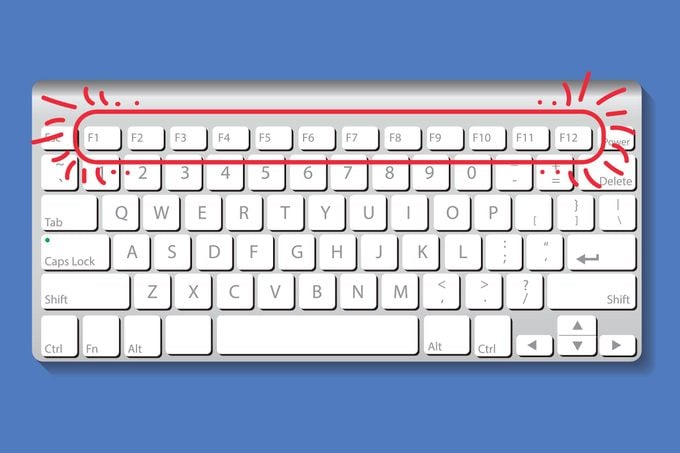
Almost every computer keyboard has a row of function keys at the top, but it seems like almost nobody knows what they do. They’re incredibly handy, however, and can be an invaluable part of your daily workflow if you know how to use them. That doesn’t mean that you need to memorize what all 12 keyboard function keys do, though. Even adding just a few of them to your typing tool box can save you hours over the long run.

“I love function keys,” says Payam Toloo, a computer specialist and founder and owner of Payam Data Recovery in Sydney, Australia. “Just like keyboard shortcuts like Control C and Control V, they save you time, and once you know what they do, it becomes as automatic as moving your legs when you walk.” If you’ve been wondering what those mysterious F-row keys do and how you can use them, look no further.

Reader’s Digest spoke to Toloo and software engineer Mircea Dima, founder of AI-powered education platform AlgoCademy, to learn more. Ahead, you’ll find everything you need to know about your keyboard’s F keys, including what each one does on both Windows and Mac computers.

Get Reader’s Digest’s Read Up newsletter for more tech, humor, travel, cleaning and fun facts all week long.

What are the keyboard function keys, exactly?

Keyboard function keys, also referred to as Fn keys, F-row keys or simply F keys, are shortcuts that allow you to control various computer menus and functions quickly and easily. These handy keys save you time by instantly performing a computer function with a simple key press, instead of having to navigate through menus with multiple mouse clicks. They’re especially useful for browsing the web and streamlining work in productivity apps like Microsoft Office.

Function keys are a favorite tool of computer professionals like Toloo. He says that once you learn what the keyboard F keys do, “you just know what key to press and what it does without thinking about it.”

Function keys date back to the 1960s, and first appeared on typewriters and teleprinters before gaining wider acceptance on HP and IBM computers in the ’70s. And although the 12-key F-row layout as we know it now dates back to the 1980s, and the core functions have remained largely the same since the ’90s, things have evolved a bit over the years.

“I have been working with computers since 1998; since that time the role of function/F-keys has changed slowly over time,” recalls Toloo. In addition, F-key functionality can depend on what operating system (OS) you’re using, and how you have your system configured.

Is there a difference between Windows and Mac function keys?

Yes. While both Windows and macOS computers have F row keys, they operate slightly differently right out of the box. Generally, Mac F keys control system settings like volume, brightness and media playback, while Windows computers use them for menu shortcuts and productivity tools. But Mac F keys can be configured to operate just like Windows function keys (we’ll show you how coming up).

“I started to use a MacBook 10 years ago, and the most common keys I press are F2 to make the screen brighter and F8 to pause/play while watching a movie or listening to music,” Toloo told us, adding that Apple briefly tried to get rid of the Fn keys altogether. “After 2016, Apple brought out the Touch Bar as a way to replace F-keys, and it was even better.” (Not everybody was a fan of the Touch Bar, though, and Toloo says they scrapped it in 2021.)

What does each keyboard function key do?

“Function keys (F1–F12) have a meaning assigned to them by your OS or the program in use,” Dima says. He notes that three F-keys stand out as particularly useful for most people: “Help menus are commonly opened by pressing F1 on Windows, F5 is used to refresh pages and F11 to toggle full-screen.”

But it doesn’t hurt to know what all the top-row keyboard special keys do, so we’ll lay out all of their functions right here:

F1

WINDOWS MAC
Opens the “Help” menu or informational documentation in most programs, such as web browsers or office apps Decreases screen brightness
Windows Key + F1: Opens Windows Help and Support

F2

WINDOWS MAC
Allows you to rename a selected file or folder in Windows Explorer Increases screen brightness
Enters edit mode in Microsoft Excel
Alt + Ctrl + F2: Opens Document Library in Microsoft Office

F3

WINDOWS MAC
Opens the search tool in many programs or windows for finding files or text Opens Mission Control
Often used as a “Find Next” shortcut in text editors, moving to the next search match
Repeats the last command entered in the Windows command line interface
Ctrl + F3: Cuts selected text to the clipboard in Microsoft Word

F4

WINDOWS MAC
Opens the address bar dropdown in most web browsers and the file explorer Opens Spotlight
Alt + F4: Closes current window or program
Ctrl + F4: Closes current tab or document

F5

WINDOWS MAC
Refreshes or reloads the current webpage or folder Activates dictation
Starts a slideshow in Microsoft PowerPoint
Opens “Find & Replace” in Microsoft Office apps

F6

WINDOWS MAC
Moves the cursor to the address bar in web browsers Toggles “Do Not Disturb” mode
Cycles through window elements in many programs
Ctrl + Shift + F6: Switches between open documents in Microsoft Word

F7

WINDOWS MAC
Activates the spell check function in Microsoft Office apps Rewinds currently playing audio
Enables keyboard (caret) browsing in most web browsers
Shift + F7: Opens the thesaurus tool in Microsoft Office apps

F8

WINDOWS MAC
Extends highlighted selection in Microsoft Office apps (such as text in Word or cells in Excel) Pauses and plays audio
Boots Windows in Safe Mode when pressed or held during startup

F9

WINDOWS MAC
Refreshes the document or selected fields in Microsoft Word Fast-forwards audio
Recalculates formulas in Microsoft Excel
Sends emails or refreshes the inbox in Microsoft Outlook
Opens a presentation in Microsoft PowerPoint

F10

WINDOWS MAC
Activates the menu bar in many programs Mutes and unmutes the audio
Shift + F10: Opens right-click menu

F11

WINDOWS MAC
Toggles full-screen mode in most web browsers and many apps Decreases the volume
Shows desktop in some versions of Windows
Shift + F11: Creates a new spreadsheet in Microsoft Excel

F12

WINDOWS MAC
Opens the “Save As” dialog in Microsoft Office apps Increases the volume
Opens the Developer Tools panel in most web browsers
Ctrl + F12: Opens document in Microsoft Word
Shift + F12: Saves a document in Microsoft Word
Ctrl + Shift + F12: Prints a document in Microsoft Word

How do you activate the keyboard function keys?

On most Windows machines, the Fn keys work as standard function keys by default—you just push them. To use the F keys on a Mac as standard function keys instead of system controls, you’ll need to hold down the Fn key, located in the bottom row, then press the F-key to use the shortcut you want. Operation may vary for nonstandard keyboards, so if in doubt, consult your particular model’s documentation or online resources.

Can you customize the keyboard function keys?

Yes. The keyboard function keys are powerful shortcuts, but you can also take their utility even further by customizing them. This can be especially useful on keyboards with more compact layouts that combine the function keys with system controls. The process for this isn’t always straightforward, however.

How to customize function keys on a Windows computer

For most people, standard Windows function keys are useful as-is. But for more advanced users who want specific functionality, the F keys can be modified or possibly disabled altogether.

“Most laptops these days can be set to switch F-key behavior in the BIOS/UEFI or system settings,” Dima says. That usually involves holding or repeatedly pressing one of the function keys while the computer is booting up, but consult your computer’s support documentation for specific instructions.

Alternatively, Windows users can install third-party software to customize the F-row key functions. This may be an easier and more intuitive option for those who aren’t comfortable tinkering in the BIOS settings. AutoHotkey is a popular app for remapping keyboard keys, including the function key shortcuts. PowerToys is a more full-featured software suite aimed at Windows power users and includes a keyboard remapping tool.

How to customize function keys on a Mac

Mac function keys double as system controls, but Apple gives you the option to turn this off, allowing your F-row to work solely as traditional Fn key shortcuts. Here’s how to enable this in current versions of macOS (Ventura or later):

  1. Open the Apple menu (represented by the Apple icon).
  2. Go to System Settings.
  3. Select “Keyboard” in the sidebar.
  4. Click the “Keyboard Shortcuts” button.
  5. Select “Function Keys.”
  6. Toggle on “Use F1, F2, etc. keys as standard function keys.”

If you’re using an older version of macOS, the process is even shorter:

  1. Open the Apple menu (represented by the Apple icon).
  2. Go to System Preferences.
  3. Select “Keyboard.”
  4. Select “Use F1, F2, etc. keys as standard function keys.”

What should you do when the keyboard function keys aren’t working as expected?

The function keys are undoubtedly a time-saver, but what do you do if your F-row shortcuts aren’t working? There are a few reasons your Fn keys may not be behaving as they’re supposed to. Here’s what to do:

Check the F-lock key

“In case they cease responding, make sure to check ‘Function Lock,'” suggests Dima. Having your F-lock key activated is the most likely culprit if your function keys aren’t working properly.

Note that this key can have different markings depending on the hardware manufacturer. Look for a key on your keyboard that says something like F-Lock, Fn-Lock, FnLk or similar. Many keyboards also have a small LED light that indicates when your Function Lock is active.

If you’re on a Mac, open the keyboard settings (following the steps listed earlier), and double-check that the “Use F1, F2, etc. keys as standard function keys” is toggled on or off according to your preference.

Update drivers and software

Some software may override standard Fn key functions, and this may be why they’re not working as expected. Test the F-keys in other programs to see if a particular app is overriding your function shortcuts. Dima also reminds users to “update keyboard drivers and test in various applications to eliminate overrides.”

The third-party keyboard remapping apps mentioned above may also cause problems. If you are using one of these, temporarily disable it to see if it doesn’t clear up any issues you’re having with your function keys.

Try another keyboard

If all else fails, try using another keyboard if you have one. Swap out your existing desktop keyboard or hook an external keyboard up to your laptop and see if the issue persists. If not, it may indicate a hardware problem with your keyboard, such as physical damage. If this doesn’t fix your function keys, however, then it’s likely some sort of software issue or possibly a computer virus.

Finally, if none of these solutions seem to work, then it may be time to have a professional technician take a look at your system.

About the experts

  • Payam Toloo is a computer expert, data recovery specialist and the founder and owner of Payam Data Recovery. He studied computer science at Macquarie University in Sydney, Australia, and is a Certified Computer Examiner by The International Society of Forensic Computer Examiners. Toloo established his company in 1998 and now operates and manages professional computer data recovery labs in five cities across Australia.
  • Mircea Dima is a software engineer and the CEO, CTO, and founder of AlgoCademy, an AI-powered coding education platform. Before founding AlgoCademy in 2020, Dima earned a Computer Science BSc from the University of Bucharest and a Parallel and Distrubited Computer Systems MSc from VU Amsterdam. He has also worked as a software engineer at top tech companies including Adobe and Microsoft.

Why trust us

Reader’s Digest has published hundreds of articles on personal technology, arming readers with the knowledge to protect themselves against cybersecurity threats and internet scams as well as revealing the best tips, tricks and shortcuts for computers, cellphones, apps, texting, social media and more. For this piece, Lucas Coll tapped his experience as a technology journalist to ensure that all information is accurate and offers the best possible advice to readers. We rely on credentialed experts with personal experience and know-how as well as primary sources including tech companies, professional organizations and academic institutions. We verify all facts and data and revisit them over time to ensure they remain accurate and up to date. Read more about our team, our contributors and our editorial policies.

Sources:

  • Payam Toloo, data recovery specialist and founder and owner of Payam Data Recovery; email interview, August 2025
  • Mircea Dima, software engineer and CEO, CTO and founder of AlgoCademy; email interview, August 2025
  • Apple: “How to use the function keys on your Mac”
  • Apple: “Create custom function keys in Terminal on Mac”
  • Microsoft: “Keyboard shortcuts in Windows”