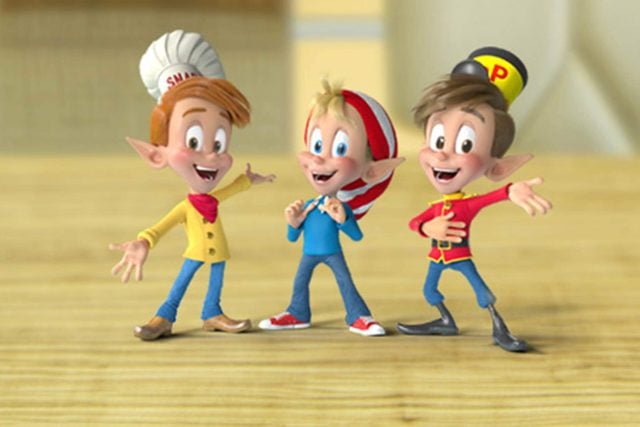
Just how effective is the marketing for Rice Krispies cereal? I knew the identities of Snap, Crackle and Pop before I knew how to do long division. Fine, before I knew how to do short division. For so many mornings in the pre-Internet age, I ate my cereal and stared at those three smiling elves on the front of that bright blue box. It’s as if they were chirping to me, “We may not have colorful little marshmallows or sugar-coated flakes, but you can hear our puffed rice soaking in milk!” It never occurred to me that these iconic characters were missing their long-lost partner in starch. Even now, as an adult who can’t resist a Rice Krispies treat, I still can’t believe there is…brace yourselves…a fourth Rice Krispies elf.

It’s true. Honestly, it’s like learning that Tony the Tiger once had a twin sister named Tonya. “It’s one of the more curious footnotes in advertising history,” Lee Gustafson, an adjunct professor of marketing at Babson College in Wellesley, Massachusetts, tells Reader’s Digest. And yet, Snap, Crackle and Pop live on and continue to pop up everywhere. “Those mascots remain a timeless reminder,” adds Gustafson, “that personality still sells.”

So, what happened to that mysterious fourth Rice Krispies elf? Read on for the full scoop.

Get Reader’s Digest‘s Read Up newsletter for more trivia, cleaning, humor, tech and fun facts all week long.

What is the origin story of the Rice Krispies elves?

First, you have to go back to the Kellogg headquarters in Battle Creek, Michigan, circa 1927. Founder W.K. Kellogg reportedly poured milk over a brand-new, toasted rice cereal in the Kellogg test kitchen and immediately approved the product. A year later, Kellogg’s Rice Krispies appeared on shelves—followed in 1929 by the first usage of Snap! Crackle! Pop! in a print ad. (FYI, the audible reaction happens due to the air trapped in each of the pieces, which are made from puffed rice, sugar, salt and rice extract. The starch changes form because of the moisture of the milk, causing it to “pop.”)

It was artist Vernon Grant who heard a radio jingle and sketched a creature for each sound. He named these characters—what else?—Snap, Crackle and Pop. As elf brothers (well, they looked more like gnomes with chef’s hats), the three first appeared in ads and posters in 1933 and were placed on the cereal boxes in 1941. “Snap was the problem solver, Crackle was the jokester and Pop was the energetic one,” Gustafson explains. “And their whimsical personalities helped Kellogg’s connect with children and parents alike.”

At the end of the decade, the boys got their first major makeover: They looked younger, their colors were brighter and their hats smaller. The Rice Krispies mascots ultimately became so entrenched in consumer culture that it makes perfect sense that their regular onscreen presence coincided with the dawn of television. Indeed, from 1948 through the mid-50s, Rice Krispies sponsored the popular children’s program The Howdy Doody Show.

Who is the fourth Rice Krispies elf?

Meet Snap, Crackle, Pop…and Pow! Resembling a boy in a space suit with elfin features, Pow made his debut in a commercial in 1954 and appeared in just two ads in total. The storyboards for the commercials revealed that while Rice Krispies’ Snap, Crackle, and Pop were brothers, Pow was simply a friend of the family. What’s more, Pow’s name didn’t represent a sound coming from the cereal bowl. Short for “power,” Pow instead represented the nutritional “punch” of the whole grain rice in the cereal. That’s why, in the first of two black-and-white commercials with the fourth Rice Krispies elf, he was introduced as a “silent partner” who doesn’t say much but still “puts powers in every lightweight spoonful of the cereal.” In both 60-second TV spots, Pow flies in on what’s purportedly a helicopter—but actually looks like a very technologically forward hovercraft.

Why did this seem like a good idea at the time?

You have to consider that in the mid-twentieth century, the space race between the U.S. and the Soviet Union was just beginning, and Americans felt a surge of excitement about the new exploration frontier. (By 1961, Alan Shepard would be the first American in space; Star Trek premiered in 1966.) To wit, Flash Gordon, the popular comic book series, was adapted into a live-action television show in 1954; and Disneyland, which opened in 1955, included the futuristic “Tomorrowland.”

So it’s no wonder that Kellogg’s got in on this early space-related culture boom. In fact, Pow’s brief stint overlapped with Kellogg’s sponsorship of the TV series Tom Corbett, Space Cadet. And one Pow-less Rice Krispies advertisement featured the three brothers zipping around on some sort of flying saucer. Also worth noting: Pow’s first commercial aired during the popular The Adventures of Superman TV series, which showed the powers of a heroic other-worldly figure. So viewers were already in an adventure frame of mind when Pow popped on the screen.

What happened to poor Pow?

After his second commercial in 1954, Pow went poof and was never seen or heard from again. (Well, until YouTube was invented and the videos became unearthed.) As to why? It probably isn’t a coincidence that Tom Corbett, Space Cadet ended its five-season run in 1955. And as an advertising mascot, Pow was kind of a dud. Because this fourth Rice Krispies elf didn’t speak or make a sound effect, there was not much to him.

“In branding, clarity and cohesion are crucial—and Pow may have muddled the message,” Gustafson says. “It’s possible the campaign’s success was so tightly linked to the original three that adding a fourth character felt unnecessary or even detrimental. Ultimately, he notes, the decision to retire Pow reflects a broader truth in marketing and advertising: “Not every idea sticks, and sometimes simplicity wins.”

Can you still find Pow anywhere?

Besides the video evidence on YouTube and those amazing storyboard drawings…Nope. On eBay, you can peruse through an array of vintage Snap, Crackle and Pop dolls. Some are still boxed and date back generations. (This cloth-made doll of Crackle with a pink gnome hat is from 1948!) But there are no signs of a Pow doll. The short-lived character is even scrubbed entirely from the Rice Krispies’ official website and the product’s timeline history. Yikes.

Are the other three elves here to stay?

For sure. These Rice Krispies characters, after all, have lasted through every consumer fad and trend for more than 90 years—and have yet to age a day. “It’s fascinating how these characters have remained relevant across generations,” Gustafson says. They’ve updated their look, but the core concept has remained unchanged.”

A brief modern history: Snap, Crackle and Pop started appearing on T-shirts starting in 1983 (after Kellogg’s began licensing the mascots) and continue to be merchandise stars. The brotherly elves lost their unwieldy black pants and belt buckles for more colorful clothing and kerchiefs in 1984; their legs and feet all became one color in 1991; and they got a more animated digital look in 2008. In 2020, Snap, Crackle and Pop became rock stars with their first single (“Vibin’) followed by a music video a year later.

And, of course, the trio continues to appear on every Rice Krispies product from Homestyle Treats to the original cereal. “The campaign’s brilliance lies in its simplicity,” Gustafson says. “It turned a mundane breakfast sound into a memorable brand signature.

About the experts

  • Lee Gustafson has been teaching courses in advertising and marketing at Babson College and Bentley University since 2020. He has held senior roles at ad agencies such as Arnold Worldwide, Mullen and O2 Ideas. His notable advertising and marketing collaborations include Bentley Motors, Radisson Hotels Worldwide, Genesee Beer and Concerto Software.

Why trust us

At Reader’s Digest, we’re committed to producing high-quality content by writers with expertise and experience in their field in consultation with relevant, qualified experts. We rely on reputable primary sources, including government and professional organizations and academic institutions as well as our writers’ personal experiences where appropriate. We verify all facts and data, back them with credible sourcing and revisit them over time to ensure they remain accurate and up to date. Read more about our team, our contributors and our editorial policies.

Sources: